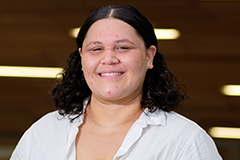
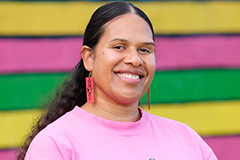
Hope Te Aka Hana

Research, Quality and Improvement Lead, Te Pā
Master of Arts in Māori Development with Honours (First Class)
Bachelor of Arts in Criminology and Criminal Justice
She chose to study criminology and Māori development because she was determined to challenge the statistics and stereotypes that too often define Māori, says Hope Te Aka Hana who completed a Bachelor of Arts in 2020, followed by a Master of Arts in 2024.
“Growing up, I saw the effects of imprisonment, intergenerational trauma, systemic inequity and cultural disconnection within whānau and communities. University helped me understand how colonisation and institutional systems can contribute to these cycles, while also deepening my belief in the strength, capability and resilience of Māori. My experiences inspired me to contribute to meaningful change, particularly by bringing Māori voices to the foreground and supporting whānau affected by the justice system. My master's thesis, Tāngata Māori Perspectives on Wellness when Resettling in the Community, centred the voices of tāngata Māori released from prison, and explored what wellness and effective tautoko mean from their perspectives.”
She still has fond memories of her time at AUT.
“A major highlight was, of course, earning my qualifications, but the most meaningful part of my AUT experience was the connections I made. I developed lifelong friendships and had the opportunity to be part of AUT Māori and the kaupapa they created for tauira. That community was central to helping me through my studies. I remain very close to several of the people I met at AUT. They’re some of my best friends and people I deeply admire for the mahi they do. AUT gave me more than qualifications. It gave me a village, a sense of belonging and relationships I will carry throughout my life.
“The workplace experience in my Bachelor of Arts was incredibly valuable. Throughout the programme, we learned a great deal of theory, but the placement also gave me the opportunity to understand what that theory looked like in practice. It enabled me to apply what I had learnt in a real working environment, develop practical skills and gain a more realistic understanding of the complexities involved in working alongside people and communities. It also helped connect my academic learning to the type of mahi I wanted to pursue after graduating.”
Supported to thrive
Hope – whose studies were supported by an AUT Postgraduate Research Scholarship Award, a Peter Harwood Scholarship in Community Leadership and Excellence, and a Freemasons Postgraduate Scholarship – says there were a number of staff whose support she particularly appreciated throughout her AUT journey.
“All of the criminology lecturers were amazing, encouraging and incredibly helpful. They inspired me throughout my undergraduate studies, especially Dr John Buttle and Associate Professor Antje Deckert. The Māori student support team was pivotal during both my undergraduate and postgraduate studies. I genuinely don’t think I could have made it through without them, particularly Talia Wiapo. They fed me, supported me with my studies, helped me navigate practical challenges and encouraged me to become more connected to my Māoritanga. I later had the privilege of working alongside them and mentoring students in the years below me.
“I also couldn’t have completed my master's degree without my supervisor, Associate Professor Teena Brown Pulu. She was my rock and an absolute godsend. Her kindness, patience, encouragement and strength-based approach carried me through some extremely challenging parts of the thesis journey. She taught me so much, and I remain in awe of the mahi she does.”
Hope has some great advice for other students.
“One of my favourite professors began every year by reminding us that university isn’t necessarily hard, but it is hard work. That advice has always stayed with me. It’s important to know your 'why'. If you’re genuinely passionate about what you’re studying and clear about where you want it to take you, you can do it. Success requires hard work, resilience and grit, but you don’t have to do it alone.
“Find your people and your support system, whatever that looks like for you, and hold on to them tightly. Remember to create balance, keep sight of your end goal and be kind to yourself when things do not go perfectly. There’ll be challenges, but if you remain connected to your purpose and accept support from the people around you, I truly believe you can succeed. Ehara taku toa i te toa takitahi, engari he toa takitini. Success is not the work of one person, but the work of many.”
Helping whānau and communities thrive
As someone who is passionate about Māori and Pasifika excellence, Hope now enjoys the positive impact she can make through her role at Te Pā.
“As a proud Māori, Samoan and Pākehā wāhine, my mahi is grounded in a deep commitment to the wellbeing and advancement of our communities. I’m passionate about addressing systemic inequities, supporting healing, breaking intergenerational cycles, and disrupting the pipelines of disadvantage and trauma that affect too many of our people.”
What she enjoys most about her work is that it enables her to contribute to kaupapa that align with both her values and her heart.
“I believe strongly in creating pathways that enable whānau and communities to thrive, and I’m grateful that my mahi gives me an opportunity to support that aspiration in a practical and meaningful way. Whāia te iti kahurangi, ki te tuohu koe, me he maunga teitei. Seek the treasure you value most dearly; if you bow your head, let it be to a lofty mountain.”
Related to this story
- Study social sciences and public policy
- Criminology and Criminal Justice Major - Bachelor of Arts
- Study Māori and indigenous development - Te Ara Poutama
- Māori Development Specialisation - Master of Arts
- Te Pou Māori - Māori student support
- Workplace experience – work integrated learning in AUT programmes