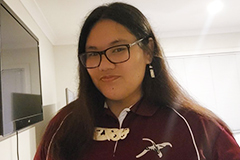
Matilda Poasa

Freelance Producer & First Assistant Director
Bachelor of Māori Development in Māori Media
When Matilda Poasa came to AUT, she knew she wanted to work in film and television. What she couldn’t have predicted was where that decision would take her, from working with Indigenous filmmakers at Sundance Institute in Los Angeles to programming film festivals, producing films and now working on set as a first assistant director.
Today, she works independently across the screen industry, collaborating with production companies, filmmakers and industry organisations on film, television and digital projects. Her work spans producing, first assistant directing, script assessment, film festival programming and talent development.
“I love that no two days are ever the same. One thing I’ve really enjoyed about my career is exploring so many different parts of the screen industry. Ultimately, I love the people and the stories most. Whether I'm helping a filmmaker develop an idea, coordinating a crew on set or supporting a project through to release, there's something incredibly rewarding about being part of a collective effort to bring stories to life, especially those that reflect our Māori and Pacific communities.”
Most recently, Matilda – who is proudly Sāmoan, with connections to the villages of Saleaula, Falelatai and Faleasi'u – was the first assistant director on Inky Pinky Ponky 2, a Pacific feature film released in cinemas in October 2026. She still gets a thrill from seeing everyone’s hard work come together on the big screen.
“Seeing a film you’ve worked on go from the chaos and magic of production to the big screen is a pretty special feeling. What I love about being a first assistant director is that it brings together so many things I enjoy: planning, problem-solving, working with people and helping turn a creative vision into reality. It's a role that requires you to think on your feet, communicate clearly and lead a team, sometimes all at once! I also continue to work across producing, script assessment, talent development and other screen initiatives, so I'm constantly learning and finding new ways to contribute to the industry.”
Finding her place at AUT
Matilda describes finding her way to the Bachelor of Māori Development as a story of “divine timing”. Culture has always been an important part of her identity, and the opportunity to study film and television through an Indigenous cultural lens made Te Ara Poutama feel like a natural fit.
“When I first applied to AUT, I didn't get into the degree I thought I wanted to do. So I freaked out, went to the AUT Student Hub and told my sad life story to Linda Strickson-Pua, the relationship manager there at the time. She told me about the Bachelor of Māori Development, walked me over to Te Ara Poutama and introduced me to Sonia Mehana, the faculty registrar. I always think of those two women as instrumental in the domino effect of people I met throughout my time at AUT.”
That was the start of the relationships that became one of the highlights of Matilda’s university experience. From her lecturers and tutors to her fellow students and wider Te Ara Poutama whānau, she found a community that supported her to succeed while encouraging her to learn by doing, work with others and bring her own ideas to life.
“One thing I appreciated about the programme was that we were encouraged to put what we were learning into practice. We had opportunities to develop our own creative projects, collaborate with others and experience the different stages of production. Looking back, one of the most valuable things I gained was an understanding of how collaborative storytelling really is. You can have the greatest idea in the world, but bringing it to life requires so many different people, skills and perspectives. I also learned the importance of being adaptable, communicating well and being open to learning from others. I've carried those skills into every role I've had since.
“One opportunity that had a particularly big impact was when I was fortunate enough to receive an AUT Internz Scholarship, which took me all the way to Los Angeles to work with the Native American and Indigenous Program at Sundance Institute. What started as an internship turned into an opportunity to stay on with the team, and ultimately became one of the most defining experiences of my career. It opened doors I never imagined possible and really set the foundation for the work I've gone on to do in the screen industry.”
Advice for other students
Matilda, who graduated from AUT at the end of 2017, has some great advice for other students.
“Firstly, the ‘do date’ is not the ‘due date’! Start your assignments early. Your future self will thank you. Be curious, ask questions, challenge yourself and make the most of every opportunity to learn. Don't be afraid to try something new or be terrible at it at first. And get to know the people around you – your lecturers, tutors, classmates and everyone you meet along the way. I can't emphasise enough how important those relationships can be, not just during your studies but long after you've graduated. Most importantly, enjoy the experience. Don't get so caught up in figuring out what you'll do with the rest of your life that you forget to appreciate where you are. You don't need to have everything figured out right now. I for sure didn't!”
For students hoping to work in the screen industry, her biggest piece of advice is simple: put yourself forward, even when you’re not convinced you’re ready.
“Apply. Seriously. Even if you don't think you're qualified enough, experienced enough or good enough, put yourself forward anyway. Let someone else decide whether you're right for the opportunity instead of deciding for them. I almost didn't apply for the AUT Internz Scholarship that took me to Sundance because I genuinely didn't think I stood a chance. Looking back, I can't imagine how different my career might have been if I'd talked myself out of it.
“The screen industry is so much bigger than the roles we traditionally associate with film and television, and you might discover something you love doing that you didn't even know existed. This industry is built on relationships, and your reputation matters. Work hard, be reliable, be kind and treat people well. Stay curious, keep learning and never assume you've reached a point where there's nothing left for someone to teach you. And for Māori and Pacific students in particular, don't underestimate the value of who you are and where you come from. Your culture, lived experiences and perspective are strengths. You don't have to leave those parts of yourself at the door to succeed. Finally, when you can help someone else, do it. Success is so much more meaningful when you can bring others along with you.”