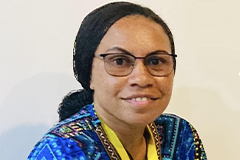
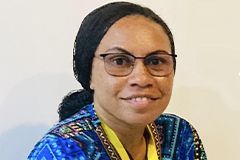
Debbie Meko
Doctor of Philosophy candidate
She has always been passionate about stroke research, says Debbie Meko who came to AUT as an international student from Papua New Guinea to complete a PhD in stroke epidemiology, supported by a Manaaki New Zealand Scholarship.
“I’ve aspired to become a clinician-researcher since my master’s degree. This PhD aligns closely with both my clinical interests and my passion for research, but more importantly, it represents an opportunity to serve my country, Papua New Guinea, where stroke is an increasing health concern. I chose to come to AUT because of the National Institute for Stroke and Applied Neurosciences (NISAN) and its strong focus on stroke research that translates into real-world impact. I feel incredibly privileged to be supervised by internationally recognised experts in stroke epidemiology and be part of an environment where research is closely connected to improving outcomes for people affected by stroke.”
Debbie’s PhD research aims to generate better evidence about the burden and outcomes of stroke and provide insights to strengthen stroke prevention and care. Her research is being supervised by Professor Valery Feigin, Professor Rita Krishnamurthi and Dr Balakrishnan Nair, with Dr Benjamin Thomas as her field supervisor in Papua New Guinea.
“My PhD has two main components. The first is a hospital-based stroke surveillance study at Papua New Guinea’s national referral hospital in Port Moresby. It aims to better understand stroke incidence, outcomes and mortality, as well as the risk factors associated with stroke among the population. The second component explores the challenges and opportunities influencing the organisation of stroke care in Papua New Guinea, particularly within the context of a low-resource health system with limited human resources and a high clinical workload.
“My research is closely aligned with a stroke unit initiative that my team and I began in 2023. The findings will provide important baseline evidence of the stroke burden and can support future evaluation, planning and strengthening of stroke services. For me, the value of this PhD goes beyond earning a degree. It’s an opportunity to address a real health problem affecting my people and contribute to strengthening stroke care in PNG and the wider Pacific. I’m deeply grateful to AUT for seeing my potential and accepting me into the programme, and to the New Zealand Government for making this opportunity possible through the Manaaki New Zealand scholarship.”
Opportunities to grow and connect
Debbie says she is particularly enjoying the academic development opportunities available at AUT.
“I appreciate having access to workshops and activities to help me grow as an emerging clinician-researcher. One of the highlights of my PhD journey was having my research abstract accepted for presentation as an e-Poster at the World Stroke Congress in Seoul. I’ll also be delivering an oral presentation informed by the data collection phase of my study and the impact the research is already having within my local hospital. In addition, I’ve been selected to moderate a session featuring approximately four presentations during the congress. I’m also grateful for the opportunity to attend the ARCOS 40-year celebration where I met the person who developed the World Health Organization STEPwise approach for stroke surveillance, which I’m currently using for my data collection. Because my research is relatively resource-intensive, I also appreciate my faculty’s funding support for my PhD project, which was something I didn’t expect as a full-time scholarship student.
“Outside of my studies, I’ve enjoyed the university’s peer-led student groups. The AUT Book Club, in particular, has been a wonderful escape from study. As a voracious reader, this avenue gives me the opportunity to relax, talk about books and connect with people outside the world of academic literature and research writing. With support from AUT’s Office of Pacific Advancement, AUT has also given me the chance to represent the Melanesian community within AUT’s wider Pacific community and contribute to policy development aimed at improving the experience of Pacific Island students.”
She admits that her studies haven’t been without challenges, but says she has felt well supported throughout her time at AUT.
“The ethics process was probably my biggest challenge, but I’ve come to understand that navigating ethics is an important part of conducting responsible research. Throughout that process, I received valuable support from my supervisors, the AUT Scholarship Office and the faculty’s peer-led groups. I’m truly grateful to Husna Harmi and the health science community at the AUT North Campus, as well as Annalise Davidson at the Graduate Research School, for their encouragement and support along the way.”
Advice for other students
Debbie – who expects to complete her PhD in 2028 – has some great advice for other students.
“There’s a world of limitless possibilities out there. But first, identify what you love doing and turn it into a purpose before you venture forward. If you pursue something you don’t love, you may not fully enjoy the process of becoming. Live in alignment with your passion and God’s purpose for your life, and watch how opportunities begin to gravitate towards you.”
She wouldn’t hesitate to recommend AUT to other students.
“I’d recommend AUT to anyone interested in pursuing a research degree in stroke, neurological conditions or related areas. The National Institute for Stroke and Applied Neurosciences provides an excellent research environment, especially for students who want their research to have meaningful clinical and real-world impact.”