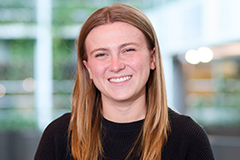
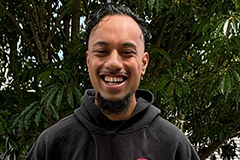
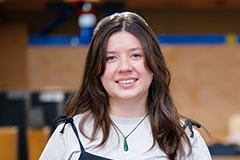
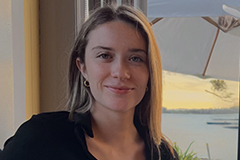
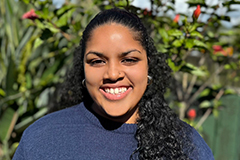
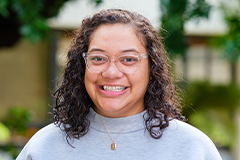
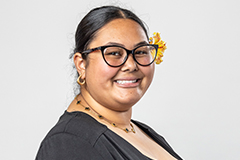
Mihirangi Harris-Tipoki
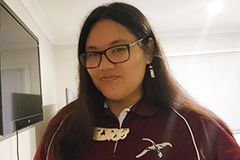
2nd-year student, Bachelor of Arts in Education with a minor in Radio and Audio Media
Diploma in Arts
She values the practical aspects of her studies, says Mihirangi Harris-Tipoki who came to AUT to complete a Diploma in Arts and has since moved into the second year of the Bachelor of Arts in Education with a minor in Radio and Audio Media.
“AUT offers a lot of hands-on learning, which I really value as it allows for practical experience rather than focusing only on the theory. This approach makes learning more engaging and helps me better understand how the concepts we’re learning about apply in real-life situations.”
Learning in such a diverse environment is another highlight for her.
“What I’ve enjoyed most about student life at AUT so far is meeting new people, especially students from different countries. The university experience is special because it creates a space where people can grow mentally, physically and culturally. Through diverse friendships, shared experiences and open conversations, I’ve been able to broaden my worldview, appreciate different perspectives, and better understand both myself and the communities around me. I’ve also enjoyed taking part in volunteering opportunities for events AUT was involved in; the Re-Imagining Māori & Home Symposium and the World Indigenous Peoples' Conference on Education (WIPCE) 2025.”
A positive step
For Mihirangi, starting her studies with the Diploma in Arts was a great way to ease into university.
“Starting the diploma really helped me ease into tertiary study, build my confidence and figure out what I actually enjoyed learning. It gave me the chance to improve my study skills and adjust to uni life without too much pressure. Looking back, it ended up being a really positive step that set me up for future study.
“I initially started with the Māori media pathway in the diploma, but I switched to education after seeing the inequality and inequity within Te Mātauranga o Aotearoa, the New Zealand education system. Through my educational journey, I’ve personally experienced and witnessed the ongoing effects of systemic racism against Māori and Pasifika communities in Aotearoa. Our education system has a long history of policies and practices that marginalise Māori knowledge, language and worldviews, including the removal of compulsory Te Tiriti o Waitangi education and the reduction of te reo Māori use within school curricula and learning resources. Changing my pathway allows me to pursue a career where I can actively contribute to challenging these inequities and work toward creating an education system that is inclusive, culturally responsive and benefits all.”
While she is still in the early stages of her studies, she already has a good idea how she would like to see the future.
“I hope to work within the Ministry of Education in the future, contributing to meaningful change within the education system. In the long term, I’d love to become the Minister of Education, where I can advocate for equity, inclusion and positive outcomes for Tangata Whenua, Tangata Moana and Tangata Tiriti across Aotearoa.”
Advice for other students
Mihirangi – who is proud of receiving a Peter Harwood Scholarship in Community Leadership and Excellence to support her studies – has some great advice for other students.
“He aha te kai a te rangatira? He kōrero, he kōrero, he kōrero. What is the food of a chief? Words, words, words.”
We can share the table, she adds.
“Use your actions to build the table and use your words to fill it with kai – to feed kindness, unity and understanding. The words you write in essays, the questions you ask in class, and the feedback you give or receive can shape your learning and your future. Speak like a true rangatira: use your words to bring ideas and people together, uphold integrity and contribute to the collective knowledge.
“Beware the way words can be used for harm – a tyrant twists words to control, to make rules and policies that benefit themselves rather than the community. Choose your words wisely, because at university and in life, they have the power to shape your understanding, your reputation and the world you are helping to build.”