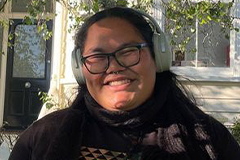
Natasha Hill

Social Media Producer, Whakaata Māori
Bachelor of Māori Development in Māori Media
When Natasha Hill studied media at school, she noticed something was missing: the Māori perspective. This realisation led her to AUT and a rewarding career in Māori media.
“I chose this degree because it offered a Māori perspective on film and media. I studied media at school, but it didn’t delve into what Māori media is and how it's applied to film and documentary making. Not many students followed the same pathway as me at the time, as my degree combined communications and Māori development within the arts. For my final course, we completed around a month of workplace experience, which was a great opportunity to gain industry experience. Some of AUT’s Māori alumni even offered to help us find placements, which was really helpful. As part of the degree, we were also given the opportunity to have a piece of writing published through the National Library of New Zealand.”
After graduating from AUT in 2022, she now loves being able to showcase Māori voices through her own work.
“I work as a social media producer for Whakaata Māori, and thoroughly enjoy my mahi and the range of skills I’ve gained across the media industry. Social media is constantly evolving, with new technology, tools, policies and creative opportunities keeping me on my toes. My work has also taken me around the motu and overseas. Alongside my social media role, I’m a trained journalist and have had the privilege of reporting on significant kaupapa.”
Supported to thrive
Natasha says she felt well-supported throughout her time at AUT.
“The transition from high school to university in the city was a big change, and I imagine many students feel the same. It helped me build resilience and take ownership of my education and aspirations. No one was checking my attendance, so I had to hold myself accountable. The cost of studying, alongside expectations to graduate, also added pressure. Looking back, that experience taught me to manage stress and thrive in high-pressure environments. Those skills have carried through to my working life, especially in the newsroom.
“Thinking back on my university experience, if it wasn’t for AUT Māori and the student ambassadors group I think it would have been more of a challenge to get through uni life. My first two years were in and out of Covid lockdown, and this meant the majority of classes were delivered online. Despite this, lecturers were supportive and accommodating to the different needs of each student. That made a big difference to my study journey at AUT. I also appreciated the university activations, including orientation week and AUT LIVE, the university open day. These helped me meet people and network across different faculties. Being chosen as a tuākana peer mentor was another highlight, and I formed close connections with many students involved in Titahi Ki Tua.”
There were a few staff who had a particular impact on her university journey.
“The Te Pou Māori team played an important role in my time at AUT, particularly Talia Wiapo, who was one of the first faces I saw there. She helped me settle in, and I believe she also supported scholarship students. Whaea Maureen – Dr Maureen Sinton, my last kaiako – continues to support me in my mahi today. Abel Kururangi Johnston, a senior student and mentor, was also encouraging and supportive throughout my studies, and we still have a great relationship. Many of the kaimahi behind the R U OK initiative also ran the student ambassadors programme and provided valuable support, and the Bright Side programme helped with my personal development and wellbeing.”
Advice for other students
Natasha has some great advice for other students.
“Take every opportunity you can. If you’re leaving high school with no idea what you want to do, trust me, you’re not alone. I was the same, but I knew I wanted to achieve big things, and I’m proud of how far I’ve come. Fake it till you make it! You’ll come across opportunities you don’t feel confident or ready for, but give them a go anyway. You don’t need to have everything figured out. Sometimes the best way to learn and grow is to back yourself and try something new. One last thing: find your people. It’s a lot easier to thrive and struggle together than alone.”
She also has some valuable tips for anyone interested in pursuing a career in journalism.
“Be resilient and believe in yourself. For me, being Māori brings an inherent sense of purpose to my mahi, and I see that as our superpower. Knowing why you do this work and what you’re passionate about helps you navigate the industry. It gives you clarity in your decisions and how you connect with people, both of which are essential in journalism. My final advice is to get experience in the field as early as you can. You really need to experience the work to understand it.”