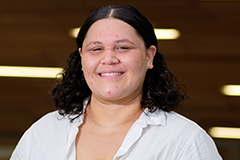
Melissa Derby

Race Relations Commissioner, Human Rights Commission
Master of Arts in Māori Development with Honours (First Class)
For Dr Melissa Derby, the most rewarding part of her job as race relations commissioner is getting out in amongst the communities and seeing their vibrancy and incredible work.
“My work is a combination of advocacy, monitoring, reporting, public engagements and more. I wish everyone in New Zealand could see what I get to see – it’s a huge privilege to spend time in our different communities. Most of the people I meet are volunteers and their contribution to this country is outstanding.
“As part of my role, I’m working with other agencies – such as the Ministry for Ethnic Communities and Multicultural New Zealand – on initiatives that promote positive connections between diverse groups. In addition to leading the Human Rights Commission’s work on race relations, I also hold the delegations for the rights of ethnic and religious communities, Pacific peoples; refugees, asylum seekers and migrants; and the right to education.”
Appointed in late 2024, Melissa comes to the role after a successful academic career in early literacy and human development, with a strong focus on Māori education — and a clear sense of purpose for her five year term.
“I’ve set a strategic focus across my term of strengthening social cohesion. My overarching message is one of celebrating our diverse communities while at the same time ensuring we connect on the many things that unite us. I’d like Race Relations Day to be more prominent in our national calendar, as I see that as a platform to celebrate our nation and the 200+ ethnicities who now call Aotearoa New Zealand home.”
Learning with purpose
Over the course of her career, Melissa has achieved a great deal — but there are two milestones she is particularly proud of.
“I’m pretty proud of my Fulbright Graduate Award, and I used my time in the USA to study the civil rights movement. What I learned from that influences me a lot as race relations commissioner, and reminds me of the importance of human rights and treating each other well.”
The second achievement was her master’s thesis, completed as part of her Master of Arts in Māori Development at AUT; a piece of work that holds particular significance for her.
“My thesis focused on the evolution of hapū identity. I wanted to capture a moment in time with my hapū in Tauranga, and the Master of Arts in Māori Development allowed me the freedom and flexibility to tell the story in a way that met the requirements of the degree while honouring my hapū and who we are. This research opened a lot of doors for me, which I’m very lucky to have had opened, but more than that, it was also a gift I was able to give my hapū. It was an honour to work with my hapū during my time completing it.”
Memories of AUT
Melissa, who completed her Master of Arts in 2016, still has fond memories of her time at AUT.
“I’ve always seen AUT as a dynamic, forward-thinking university, and the experience studying there confirmed that. I had great teaching and supervision, and I loved the wānanga run on weekends, with kai in the marae and plenty of time for whakawhanaungatanga with other students and staff. The weekend sessions meant that I could keep on working full-time while studying. I was proud that my master’s degree thesis made the dean’s List, and as a result of the honour, I received scholarships and awards to complete my PhD.”
Her advice for other students is simple: slow and steady wins the race.
“If you’re completing a thesis, one foot in front of the other every day is a much better approach than leaving it all to the last minute. Set goals and go for it, but don’t forget to check the unexpected opportunities that may be hidden down the side roads.”