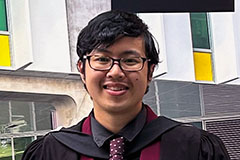
Oswald Tovutovu

Engineer, IPVPN Services, Solomon Telekom Company Limited (STCL), Solomon Islands
Bachelor of Computer and Information Sciences in Networks and Cybersecurity with a minor in Artificial Intelligence
Choosing to study at AUT was one of the best decisions he made during his academic journey, says Oswald Tovutovu who came to AUT as an international student from the Solomon Islands, supported by a Manaaki New Zealand scholarship.
“One of the greatest highlights for me was meeting students from many different cultural and international backgrounds. Being an international student can sometimes be challenging, especially when you’re away from your family and home community. However, AUT’s diverse student body made it easier to build friendships, feel connected and learn about different cultures. Another major highlight was being involved with Pacific student groups, including Māori and Pasifika in STEM (AUTMAPS) and the AUT NIU Collective. These groups gave me a strong sense of belonging and enabled me to connect with students from across the Pacific.
“AUT also provided a wide range of support services that helped me throughout my university journey. The AUT Employability Lab was particularly helpful in preparing me for life after university. The team supported me with career planning and helped me better understand what employers and recruiters look for in graduates. I also completed the AUT Edge Award, which helped me develop important skills in leadership, communication, collaboration and community engagement. The AUT scholarship staff were also very supportive throughout my studies. They encouraged me to make full use of the services and opportunities available at AUT and helped to ensure that I had a positive experience in New Zealand as an international student.”
He also appreciated the practical aspects of his degree.
“My programme included practical labs, applied technical projects, problem-solving activities and opportunities to connect with professionals from the technology industry. The hands-on learning experiences enabled me to work with networking technologies, cybersecurity concepts and real-world technical scenarios, and showed me how the theories taught in class are applied in professional environments. AUT also provided opportunities to learn from major technology organisations and industry professionals, including people working with Google, Amazon Web Services and Microsoft. These opportunities gave me a better understanding of different technology careers, workplace expectations and the skills required to succeed in the industry.”
Solving tech problems
After graduating from AUT at the end of 2025, Oswald has now returned to the Solomon Islands where he works as an engineer for the Solomon Telekom Company Limited (STCL).
“I enjoy solving technical problems and helping customers maintain reliable network connectivity. My role gives me the opportunity to investigate network issues, troubleshoot services and find practical solutions. One of the most satisfying parts of my job is seeing the positive impact of solving a customer’s problem. Knowing that I’ve restored a service or improved a customer’s experience gives me a strong sense of achievement. I also enjoy that the technology industry is constantly changing. There’s always something new to learn, which encourages me to continue developing my technical knowledge and professional skills.”
He says his time at AUT prepared him well for the complexity of solving real-world technology problems.
“During my studies, I learned technical theories and concepts, but also developed the ability to analyse problems, test possible solutions and communicate clearly with others. I didn’t initially realise how important these broader skills would be in my professional career. AUT also prepared me to continue learning independently. Technology changes quickly, so having the confidence and ability to learn new systems is extremely important.”
Advice for other students
Oswald has some great advice for other students who are thinking about their own university journey.
“My advice to future AUT students is to always try to stay one step ahead in both your academic and non-academic journey. Avoid leaving assignments, projects and important responsibilities until the last minute. Producing quality work takes time, preparation and consistent effort. Take advantage of the practical learning opportunities, support services, student clubs and networking events at AUT. Some of the most valuable lessons and connections can come from experiences outside the classroom. Don’t be afraid to ask questions or seek help when you need it. Your lecturers, tutors, classmates and AUT’s support services are there to help you succeed.”
He also has some guidance for those interested in a career in technology.
“Completing a degree is an important achievement, but technology continues to change, so you must continue developing your knowledge and skills throughout your career. Build practical experience whenever possible. Create personal projects, practise in virtual labs, take part in internships, volunteer and look for opportunities to apply what you have learnt. It’s also important to develop communication, teamwork and problem-solving skills. Working in technology isn’t only about understanding systems and devices. You also need to explain technical issues clearly, work with different teams and understand the needs of customers.
“Don’t feel that you need to know everything before applying for a role. Be confident in the knowledge you already have, remain honest about what you’re still learning and show employers that you’re willing to grow. Finally, remember where you come from and think about how you can use your skills to contribute to your community.”
Related to this story
- Study engineering, computer and mathematical sciences
- Networks and Cybersecurity Major - Bachelor of Computer and Information Sciences
- Manaaki New Zealand Scholarships
- Clubs and societies for AUT Business School students
- Employability and career support
- AUT Edge Award: develop leadership and employability skills