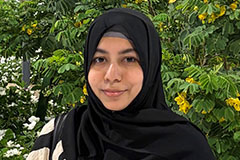
Rubana Tasnim Esha

Master of Design student
She’d highly recommend AUT’s Master of Design to those looking for a degree that pushes them further on their creative and design journey, says Rubana Tasnim Esha who came to AUT as an international student from Bangladesh.
“The environment here is very motivating, and the facilities, events and people are all very helpful, especially for international students from diverse backgrounds. I appreciate having my own studio space, which gives me enough room for the creative part of my research. I value the facilities AUT provides, such as the bindery facility and the 3D fabrication lab, and how the staff there are always helpful and welcoming. Receiving an art and design master’s research materials grant to support the material costs of my research project was also very helpful.
“I've really appreciated the independence I have over my creative research project, which enables me to work on something I'm truly passionate about. AUT has also introduced me to Māori concepts like whakapapa, which has inspired me to reflect more on my own heritage and where I come from, something I now see as one of my biggest sources of knowledge. My supervisors and lecturers have been thoughtful and supportive, and on some days during class our lecturers would bring in food to share. That was unexpected but nice. Overall, I appreciate being surrounded by likeminded, creative people, which creates an environment that motivates me to keep going.”
Bringing art and music into research
Rubana says she has always been passionate about art and music.
“This passion led me to complete my Bachelor of Fine Arts at the University of Rajshahi in Bangladesh. Alongside that, I trained as a traditional Bengali singer from the age of five. Combining these two backgrounds, I wanted to create something that reflected my identity while also exploring my passion for interactive media. While visiting New Zealand in 2023, I had the opportunity to visit AUT and meet people there, which motivated me even more to apply for this degree.”
For her master’s degree research, she is drawing on those long-time passions, under the supervision of Professor Welby Ings and Dr Ivana Nakarada-Kordic.
“My research investigates how an interactive AR picture book, drawing on Bangladeshi folk culture, can support affective literacy in children aged five to eight through co-reading with caregivers. Affective literacy here is the ability to recognise pre-verbal bodily sensations and connect them to what a child is feeling. Growing up, I didn’t receive any formal education on this side of myself, which left a gap that stayed with me. I always relied on music and art to reach my inner world. Noticing this early gap, along with the limited opportunities I had as a child to talk with my parents about my feelings, shaped my interest in this research.
“The story introduces children to different feelings – such as happiness, sadness, fear, anger and love – through the protagonist of the book, who experiences each on her journey. Selected pages will include augmented reality features, which the caregiver triggers with a smart device such as a phone or tablet, alongside the child, bringing animations and folk instrument sounds into the story to make it more immersive. This project is informed by my lived experience as a Bangladeshi fine arts practitioner and traditional singer, which gives me a personal foundation for the creative decisions throughout this work.”
Advice for other students
Rubana, who expects to complete her studies in mid-2027, has some great advice for other students.
“My advice would be to push past your comfort zone and attend the campus events, especially if you're an international student. It's a great way to connect with new people, and in the creative field building connections is important. Being in good health is also important, so make sure to take breaks occasionally, and take care of both your mental and physical health.”
Studying far from home hasn’t always been easy, she admits, but says she appreciated the support available to help her adjust to life in Auckland.
“The biggest challenge for me was at the very beginning. Being an international student in a new country, with new ways of studying while also trying to find part-time work to support myself, was difficult. The programme is designed in a way that gives me enough time outside of campus to focus on myself. Alongside this, the Student Hub, AUT's Employability and Careers team and the Student Medical Centre have all been a great help.”