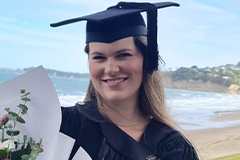
Luke Bretnall

Interior Designer, Golden, Melbourne
Master of Design with Honours (First Class)
Bachelor of Design in Spatial Design with a minor in Design for Sustainability
He was drawn to the exploratory nature of spatial design, says Luke Bretnall who came to AUT to study a Bachelor of Design in Spatial Design, soon followed by a Master of Design.
“I had decided very late that I wanted to pursue a design career. The freedom to explore different ways of thinking, making and creating in the spatial design degree is what hooked me in. It’s what makes the course so unique. I think this is why you see so many graduates from spatial design at AUT go on to work across many different industries; it really embodies the idea of ‘interdisciplinary’.
“The highlight for me was the engagement with peers, lecturers and technicians. Forming relationships with the people around me not only assisted my growth as a designer but also created a sense of belonging that was invaluable during my time at AUT. I also appreciated that the spatial design programme had very good connections with studios and designers. The department would often host design workshops where invited designers critiqued student work and discussed their experiences in the industry. The biggest worry for most students is the bridge from university to industry, and these sessions really helped to ease a lot of that worry.”
While he found the entire spatial design department amazing to work with, he says there were a few staff members whose support he especially appreciated.
“My supervisors – Dr Emily O’Hara and Associate Professor Susan Hedges – both offered immense care and support during my research, while also being tough and grounding me when needed. I also thoroughly enjoyed my time working alongside Lisa McEwan, Dr Rachel Carley and Dr Rafik Patel as a teaching assistant, and felt very special having previously been their student. The technicians in the labs at AUT were incredible too. Harriet Stockman and Angus Roberts from the 3D fabrication labs were integral to my making practice, and they continuously went above and beyond to help.”
Using design to understand emotions
Having thoroughly enjoyed his Bachelor of Design, Luke jumped at the opportunity to take on a Master of Design as well.
“My master’s degree research focused on exploring grief and mourning through a creative design practice of casting, using domestic space as the site of investigation and drawing from a personal narrative of losing a loved one, which served as the underlying driver of the work.
“Although this research took many iterations to become what it ultimately became, I chose this research path because it was deeply personal. The underlying narrative gave me a lot of motivation for my work, and it was already something I didn’t know how to navigate very well. Putting that through the lens of my research allowed me to utilise design in a way that I didn’t think was possible; to understand feelings, emotions and intangible things in a physical way. I was very happy to have some of my early Master of Design research included in a conference paper publication, presented at an overseas annual design conference.”
Postgraduate study also opened the door to another opportunity for him – teaching alongside some of his former lecturers.
“A big highlight and ‘full circle’ moment for me was teaching alongside my former lecturers as a teaching assistant during my Master of Design. Going from being their student to working with them as a colleague was incredibly rewarding, especially being able to help students navigate the same questions I’d had only a short time earlier.”
From ideas to buildable environments
After graduating with his Master of Design in 2022, Luke now loves working as an interior designer for Golden in Melbourne.
“I get great satisfaction working through the stages of a design project, from a conceptual idea or client conversation to the fully formed design package with technical drawings and real-world design solutions. Being able to successfully answer a client's brief and create something that everyone is proud of gives me my drive as a designer. Getting to work alongside other designers, artisans, builders and engineers across residential and commercial projects has helped me develop a more integrated design understanding of how we translate design ideas and concepts into functional, safe and buildable environments.”
He has some great advice for other students interested in a similar career.
“Your experience is shaped by the effort you invest. The Bachelor of Design in Spatial Design and the Master of Design are degrees that deeply reward curiosity, initiative and genuine engagement. Engage with your peers and tutors, stay open to unexpected directions (there will be many) and allow yourself the space to discover what is and isn’t important to you creatively and personally.
“Awards and achievements are great things to strive for, but your time at university is also a rare opportunity to freely experiment before stepping into professional practice. Use that time to work out what kind of designer you want to become. This was the absolute best thing I took away from my time at university.”