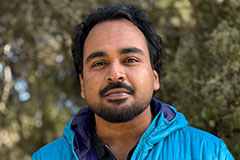
Tebwebwekiari (Tebwebwe) Kienene

Master of Public Health student
Her goal is to bridge research, policy and practice to create sustainable health improvements in Kiribati and across the wider Pacific region, says Tebwebwekiari (Tebwebwe) Kienene who came to AUT supported by a Manaaki New Zealand Scholarship.
“As a medical officer working in the main hospital in Kiribati, I’m acutely aware that Kiribati has one of the highest under‑five mortality rates in the Pacific. My clinical experience, combined with the knowledge gained through a postgraduate diploma in child health, has deepened my understanding of the complex challenges facing children and families. Too often, children present to hospital when their conditions are already advanced, and despite our best efforts, interventions come too late. These experiences have convinced me that while clinical medicine is essential, it must be complemented by a broader public health approach.
“The Master of Public Health equips me with the analytical and leadership skills to move beyond treating individual cases towards addressing the upstream determinants of health. Through this programme, I aim to design and implement strategies that reduce childhood mortality, strengthen community awareness and build sustainable health systems that protect children before they become critically ill. By integrating my clinical expertise in child health with advanced public health training, I can contribute to evidence‑based policies and interventions that improve outcomes not only in Kiribati but across the wider Pacific region. My goal is to progress towards a career dedicated to reducing childhood mortality and advancing equity within health systems.”
Integrating research, policy and practice
She has particularly valued the way the Master of Public Health integrates research, policy and practice, says Tebwebwe who is proud of receiving the Manaaki Academic Excellence Award.
“Learning from lecturers who not only possess deep academic knowledge but also bring extensive professional experience has enriched my understanding and provided practical insights into real‑world health challenges. AUT has given me the confidence to connect my cultural background and lived experiences with academic research, allowing me to see how these perspectives can make meaningful contributions to public health scholarship. Through this process, I’ve become more assured in my ability to critically analyse health challenges and propose evidence‑based solutions that reflect both local realities and global frameworks. I now feel more confident not only in my research but also in my capacity to contribute to the wider public health discourse and to future initiatives aimed at improving child and family health across the Pacific.
“Networking with colleagues from diverse cultural and professional backgrounds has broadened my perspective and enabled me to engage with global health issues through multiple lenses. This exposure has been invaluable as it has deepened my understanding of how public health challenges and solutions vary across contexts. Importantly, I’ve built meaningful connections not only with fellow students but also with lecturers, whose guidance and expertise continue to shape my learning.”
There are a few staff whose support throughout her studies she has especially appreciated.
“I’m particularly grateful to the Manaaki scholarship team, and especially to George Kimani, whose support has ensured that my academic journey has been both smooth and sustainable. I also wish to acknowledge the dedication of the library staff, whose assistance has enhanced my ability to access and utilise resources effectively. Finally, I’m deeply appreciative of Associate Professor Nadia Charania for offering to supervise my dissertation on vaccine hesitancy among Pacific migrants. Her expertise and mentorship have been invaluable in shaping my research direction. Collectively, these contributions have made my academic journey at AUT both meaningful and rewarding, reinforcing my confidence in pursuing impactful public health scholarship.”
Advice for other students
Tebwebwe’s advice for other students is simple: success at AUT comes from consistency and balance.
“Never leave your assignments to the last minute – planning ahead and working steadily makes the journey far less stressful and ensures the quality of your work.”
Make space for self‑care and enjoy the unique experiences New Zealand has to offer, she adds.
“A healthy mind and body are essential for academic excellence. Personally, as a spiritual person, I find strength in making time for church, where I can reflect and give thanks for the many blessings in my journey – supportive colleagues, dedicated lecturers and the academic services that have guided me along the way. While everyone’s path will look different, finding your own rhythm of discipline, balance and gratitude can make the academic experience both successful and fulfilling.”