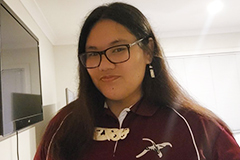
Lynette Parker Hay
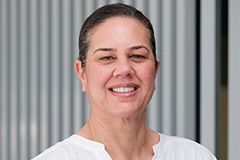
Doctor of Education student
For Lynette Parker Hay, doctoral study has brought together her experience as an educator, her Niue identity and her connection with Vagahau Niue in ways she hadn’t expected.
“AUT has allowed me to connect parts of my life that I had previously thought about separately: my work in education, my experiences as an ever-developing speaker of Vagahau Niue, my Niue identity and my involvement in Polyfest. I didn’t expect doctoral study to make me examine my own assumptions and practice so closely. That has been challenging at times, but it has also helped me see that lived experience can be a valuable starting point for research when it is approached critically.”
Her proposed research builds on these connections, exploring how collaborative composition of lologo could create opportunities for young Niue people in the diaspora to use and develop Vagahau Niue.
“My planned research explores how young Niue people in the diaspora, who may understand more Vagahau Niue than they speak, could use collaborative composition as an opportunity to produce and negotiate meaning in the language. I’m interested in what happens while a lologo is being written: how young people try out language, move between English and Vagahau Niue, and work with more proficient speakers.
“The biggest challenge has been learning to be comfortable with not having all the answers. My research topic is closely connected to my identity and practice, so feedback can require me to step back from ideas I feel strongly about and examine my assumptions. The lecturers have supported me through honest, constructive feedback and conversations that help me clarify my thinking.”
The next step
After 29 years working in education, Lynette sees doctoral study as a natural next step and an opportunity to keep challenging herself and growing as an educator.
“Throughout my career, I’ve always wanted to be the best educator I can be. For me, that means never reaching a point where I think I have learnt enough. I want to keep growing, challenge my thinking, and develop the knowledge and skills to make a genuine difference in the lives of others. At this stage of my life and career, pursuing a doctorate feels like a natural next step. I have a wealth of experience to draw on, but I also know there is still so much to learn.”
She was drawn to AUT because of the Doctor of Education’s practical focus and the flexibility to continue working while developing her research.
“I chose AUT because the programme felt more down to earth and closely connected to practice. The Format 3 pathway especially appealed to me because it gives me the opportunity to produce something grounded in the realities of education and useful in the field, rather than work that sits only in theory.
“What I’ve enjoyed most is how personable and supportive the lecturers are. I feel that they’re genuinely invested in my success, and that means a great deal to me. I also value the Format 3 approach and the part-time structure of the programme. They enable me to remain connected to professional practice while developing my research and thinking over time.”
Advice for other students
Lynette has some great advice for other students who are considering doctoral study.
“Don’t wait until you feel completely ready. Bring your experience with you, but be open to having it questioned and to seeing it differently. Ask for help early, and give yourself time to read, write, reflect and respond to feedback. Most importantly, choose a topic you care enough about to stay with when the work becomes difficult.”
She wouldn’t hesitate to recommend the Doctor of Education.
“I’d recommend this programme to experienced educators who want to examine their practice seriously and contribute something useful to the field. It’s demanding, and you need to be willing to question your own thinking and sit with uncertainty. At the same time, the lecturers are supportive and the programme is flexible enough to remain connected to the realities of professional practice.”