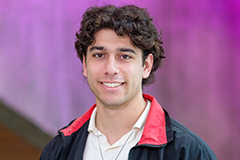
In Kuan Lee (Jasmine)

Master of Design student
Bachelor of Design in Spatial Design
She has always been fascinated by how spaces can tell stories through atmosphere, movement and emotion, says In Kuan Lee (Jasmine) who came to AUT as an international student from Macau.
“I came to AUT to study a Bachelor of Design and felt that now was the right time to formalise my curiosity into rigorous research with a Master of Design, especially as the contemporary art world is increasingly interested in immersive, experience-driven practices. I wanted to move beyond traditional object-making and learn how to construct environments that provoke critical reflection and emotional resonance.”
AUT’s strong emphasis on research-led practice and its open, interdisciplinary approach to art and design made it an easy choice for her postgraduate study.
“Unlike more conservative universities, AUT encourages experimentation and critical thinking – values that are essential for my project. The School of Art and Design also offers excellent workshop facilities and studio spaces that allow me to test spatial ideas at scale, which is crucial for installation-based work. Most importantly, I felt that AUT’s supportive academic culture would give me the freedom to explore challenging, even unsettling, themes with intellectual integrity.”
Translating emotions into a spatial experience
For her Master of Design research, Jasmine is creating a spatial installation inspired by a pivotal moment in the life of Japanese author Osamu Dazai, one of Japan’s most influential yet controversial literary figures.
“During a fireworks festival, Dazai was witnessed kissing an admirer in public while his wife and young daughter were nearby – an event that triggered public scandal, shame and emotional rupture, exposing the deep conflict between his private desires and social identity. My installation translates the event’s emotional atmosphere into a spatial experience. Through suspended lights, fragmented texts, scorched flowers and shifting shadows, I create an environment where beauty and collapse coexist; much like fireworks that bloom brilliantly and vanish in an instant. Visitors are invited to experience a suspended moment caught between intimacy, judgement, memory and disappearance.
“Importantly, my installation doesn’t aim to offer an authoritative interpretation of Dazai. Instead, it provides a space for audiences to engage with him through atmosphere and emotion. Some may empathise with him; others may question or criticise him. Like his own works, this piece remains open to multiple readings; there is no single fixed answer. This openness is central to my interest in critical spatial practice and the Japanese aesthetic concept of mono no aware; the bittersweet awareness of the transience of things.”
She says her supervisors – Dr Sue Gallagher and Caroline Powley – have been incredibly supportive and insightful throughout her research journey.
“What I’ve enjoyed most is the intellectual freedom and the genuine curiosity that my supervisors and peers bring to my project. Even though my research deals with heavy and complex emotional territories – shame, collapse and contradiction – I’ve never felt that I had to simplify or soften it. Instead, AUT has encouraged me to lean into the discomfort. I didn’t expect to be given so much trust to pursue a project that is deeply personal, culturally specific and conceptually demanding.
“The studio culture here is wonderfully diverse, and I’ve had many conversations with fellow students from different disciplines that have unexpectedly enriched my understanding of spatial narrative. Additionally, the access to specialised workshops – including 3D printing, printmaking and digital labs – has enabled me to bring my wildest ideas to life in ways I never thought possible.”
Advice for other students
Expecting to graduate later this year, Jasmine has some great advice for other students interested in postgraduate study in design.
“My advice is to embrace the uncertainty. Your research won’t always be detailed and that is okay; some of the most powerful insights emerge from the spaces of not-knowing. Be honest with yourself and your supervisors about what you’re trying to do, even if it feels messy or contradictory. Finally, remember that your work doesn’t have to please everyone. Like Dazai’s writing, or like a firework, it can be beautiful precisely because it’s fleeting, unresolved and open to interpretation.”
She wouldn’t hesitate to recommend AUT’s art and design programmes.
“If you’re someone who wants to explore difficult questions, who is not afraid of ambiguity, and who believes that art and design can be a form of critical inquiry, then AUT is an exceptional place to do that. The support system – both academic and technical – is strong, and the interdisciplinary environment means that you’re constantly learning from perspectives outside your own field.”