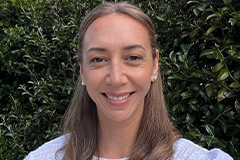
Carah Achas

Master of Public Health student
Carah Achas first became interested in how people’s health is shaped by their working conditions, income and access to opportunities when she was studying as a chemical engineer in the Philippines. This interest would soon lead her to AUT’s Master of Public Health, supported by a Manaaki New Zealand Scholarship.
“I felt that these underlying social determinants of health deserved greater attention, especially back home in the Philippines. I wanted to understand how I could contribute to addressing them. The opportunity came through the Manaaki New Zealand Scholarship, funded by the Ministry of Foreign Affairs and Trade (MFAT). When I saw public health among the available study options, I took the chance. It was the right time to build on my engineering background and pursue a growing sense of purpose. Now, at AUT, I’m learning how to turn that interest into research and action that can support healthier, more equitable communities. I was drawn to the university’s emphasis on connecting learning with real-world challenges.”
Her master’s degree research is a great opportunity to put her knowledge into practice, and she is focusing on a common public health hazard: asbestos.
“Asbestos was once widely used in building materials because of its strength and resistance to heat. However, breathing in its tiny fibres can cause serious diseases, including lung cancer, mesothelioma and asbestosis, which scars the lungs. These illnesses can take decades to develop, so the consequences of exposure may remain invisible for years. It’s known as New Zealand's number one silent killer in the workplace.
“My research explores how Filipino migrant construction workers in Aotearoa New Zealand understand and experience workplace asbestos exposure. I’m interested in their awareness of the risks, the training and protection they receive, and whether they feel able to raise concerns or refuse unsafe work. Understanding a hazard is one thing; being able to protect yourself when language barriers or worries about job security come into play is another. Through interviews, I hope to understand these challenges from workers themselves and help inform better health and occupational safety policies for underserved groups. Everyone deserves to earn a living without putting their future health on the line.”
New friends and experiences
Expecting to complete her studies in 2027, Carah is thoroughly enjoying her time at AUT.
“I’ve loved meeting people from different cultures, and AUT certainly offers plenty of opportunities for that. Within my scholarship cohort alone, I’ve met people from Suriname, the Marshall Islands, Saint Lucia and many other countries I’m slightly embarrassed to admit I hadn’t heard of before. My geography has improved, but more importantly, so has my perspective. Hearing their stories has made me realise how small my window on the world was when I arrived, and how much I still have to learn. It’s been a lovely, humbling part of studying here.
“Some of my most meaningful learning has happened beyond the classroom. Volunteering with Migrant Action Trust has brought me into contact with migrants navigating challenges in their everyday lives. Reading about these experiences in journal articles is one thing. Sitting with someone and hearing their story brings a different depth of understanding. I’ve also presented my research at the Asian Academics for Aotearoa (A4) Symposium, where I connected with people who share similar interests and learned about their work. These experiences remind me that research begins with curiosity, but its purpose comes back to people.”
Being based in Auckland for her studies in New Zealand has been another highlight for her.
“Living in the Auckland CBD has its perks. My gym is right downstairs, so even my excuses have nowhere to run when I need to work off some stress. There are also plenty of green spaces where I can slow down and recharge. I hear people complain about bus schedules, but having a timetable to plan around already feels like a privilege to me. Knowing a bus arrives in roughly 15 minutes, at a designated stop, without having to queue is an appreciated convenience. I’ve enjoyed the weather too, although Auckland does like to keep us guessing.”
Highly recommended
Carah wouldn’t hesitate to recommend AUT to other students.
“I would recommend the Master of Public Health to anyone interested in understanding the conditions that shape health and addressing inequities across communities. Its focus on prevention, health equity and the social determinants of health encourages students to examine how social, economic and political systems influence people’s opportunities to live healthy lives. I particularly value the programme’s emphasis on critically evaluating evidence, engaging with community perspectives and working collaboratively to address complex public health challenges. It has strengthened my ability to connect research with policy and practice, contributing to more equitable health outcomes.
“Knowing that AUT offers support for students experiencing difficulties gives me peace of mind. Balancing academic demands and personal wellbeing can be challenging, especially when you’re far from home, so it’s reassuring to know there is somewhere to turn. AUTSA provides independent advocacy and opportunities to connect with other students through clubs, cultural communities and events. Its Tautoko service also assists students experiencing financial hardship. For me, knowing that this wider support network exists is comforting. It helps me approach my studies with greater confidence and reminds me that being independent doesn’t mean having to figure everything out on my own.”
Her advice for other students is simple: live.
“Live. It’s just one word, but it’s something I try to remind myself of when studying starts to take over. Take a walk without feeling guilty about the work waiting for you. I care about doing well, and I know how easy it is to feel that every spare hour should go towards another reading or assignment. But I also want to look back on this time and remember the places I explored and the people I shared it with. For those of us who are only in New Zealand for a few years, especially my fellow Manaaki scholars, these opportunities feel precious. Hence, study hard and be proud of what you achieve, but give yourself permission to enjoy the journey too. I want to leave with a degree I worked hard for and stories I’ll still be telling years from now.”