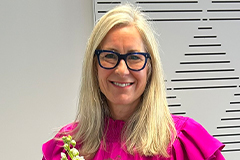
Amanda McFadden
Clinical Psychologist & Neuropsychologist, BEAM Clear Thinking
Doctor of Health Science
Dr Amanda McFadden decided to undertake the Doctor of Health Science after many years in psychology practice, driven by a sense that there was still important work left to do academically. While she had progressed quickly through her early training, qualifying at a young age, she says the idea of doctoral study never fully went away.
“I love practice, but I've always loved academia and the challenge of completing a really advanced degree has always been an attractive one for me at a personal level. In the back of my mind, it always felt like there was something more to do. Years later, I had an established private practice and two young children, and was doing the maths in my head. If I waited until the boys were older, I’d probably be close to 60 when I finished. If I started earlier, I’d still have a part of my career ahead of me where it could really have an impact.”
What ultimately tipped the balance was finding a programme that felt achievable and relevant.
“I had a couple of colleagues who enrolled in the Doctor of Health Science while also working, and they were both quite positive about the programme. They encouraged me to do it. The programme was a good fit for me and I appreciated that it was strongly applied in its focus. It had been 20 years since I last studied, and I liked the fact that you could turn up to some lectures and have set things to do. I felt that if I was left to my own devices, it wouldn't really happen. This seemed the most realistic way of getting back into it.”
At the intersection of psychology and the law
Amanda’s research was firmly rooted in her work as an expert witness in criminal, family and immigration contexts, where psychological opinion carries significant weight.
“My doctoral research examined how specialist assessors integrate human rights perspectives into assessments under New Zealand’s Intellectual Disability (Compulsory Care and Rehabilitation Act). I’m one of a relatively small group of psychologists and psychiatrists in New Zealand writing reports for court for really vulnerable people. I operate within some quite specialised pieces of legislation for those groups, and have always been fascinated by how psychology and the law intersect – and sometimes clash.”
Academic rigour was an important part of the experience for her.
“I don’t think there are any shortcuts with a doctorate. While you start your studies with courses, you’re still doing the writing just like you would if you had taken a traditional PhD route. It was years of work and thousands of hours, and my thesis that was still a really lengthy process. My research combined law and psychology topics, and was very rigorous. I think I had the benefit of three supervisors – Professor Kate Diesfeld and Professor Warren Brookbanks from AUT, and Associate Professor Brigit Mirfin-Veitch from the University of Otago – and felt very well supported.”
Professional impact and credibility
Completing the doctorate sharpened Amanda’s professional capability in ways she says are now deeply embedded in her work.
“It’s definitely improved my writing, my critical thinking, and my ability to move quickly through the literature. You don’t always appreciate it at the time, but later you realise how much you actually know. The doctorate also changed how my expertise is received, particularly in legal settings. When you’ve got ‘Doctor’ in front of your name, what you’re saying carries more weight, and that credibility matters in adversarial environments where expert opinion is closely scrutinised.”
Importantly, the doctorate didn’t push her towards a wholesale career change.
“I went in thinking maybe I could stop being a clinician and could be more of an academic. I have presented my research at conferences and have plans to publish my work, but I’ve come out of the experience knowing how much I love what I do.”