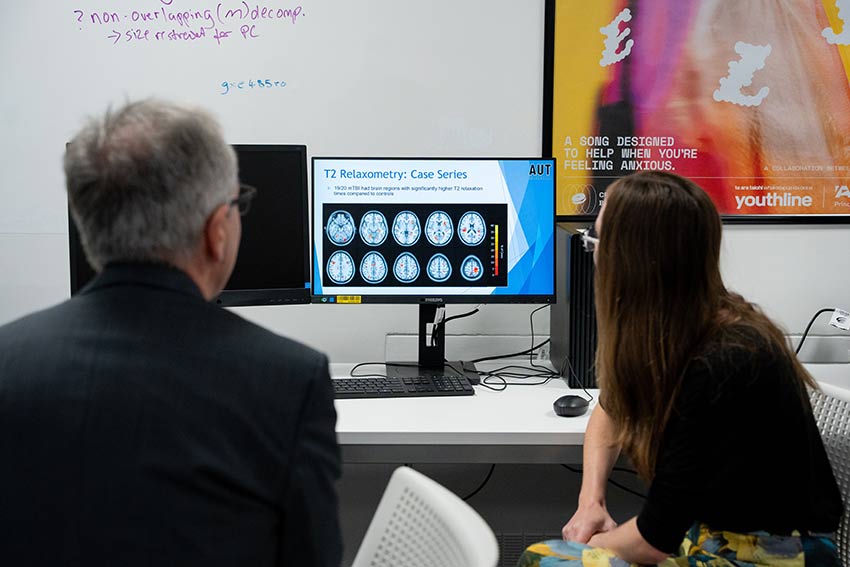
Psychology and neuroscience department
AUT’s Department of Psychology and Neuroscience brings together teaching and research in psychological science, neuroscience, mental health and human behaviour. We offer undergraduate and postgraduate programmes in psychology, applied psychology and professional psychology, as well as the assistant psychology pathway.
Our research community is supported by leading institutes and facilities, including the AUT Brain Health Research Institute, AUT Cognitive and Computational Neuroscience Laboratory, and AUT Stroke and Applied Neuroscience Research Centre. Our researchers work across psychological science, mental health, behaviour change, cognition, brain imaging, concussion, epilepsy and neurological health. Together, our teaching and research contribute to a better understanding of people, behaviour, health and wellbeing.
Undergraduate study in psychology and neuroscience will give you a solid grounding in this area.
The Psychology and Neuroscience department offers a range of postgraduate degrees:
- Bachelor of Arts (Honours)
- Bachelor of Health Science (Honours)
- Postgraduate Certificate in Arts
- Postgraduate Diploma in Counselling Psychology
- Postgraduate Diploma in Psychological Assistance
- Master of Arts in Psychology
- Master of Health Science
- Master of Philosophy
- Doctor of Health Science
- Doctor of Philosophy
Online study options for psychology – offered by AUT Online
Research in psychology and neuroscience
We believe in high-quality research that has impact, and have world-class researchers and research strengths across psychology and neuroscience.
Browse research expertise

Contact us
Get in touch to find out more about our programmes:
- Email csoc.general@aut.ac.nz (for the Bachelor of Arts in Psychology, Bachelor of Arts (Honours), Postgraduate Certificate in Arts and Master of Arts in Psychology)
- Email science.admin.team@aut.ac.nz (for other undergraduate programmes)
- Email science.postgraduate.admin@aut.ac.nz (for other postgraduate programmes)