Meaningful assessments equate to degrees that matter
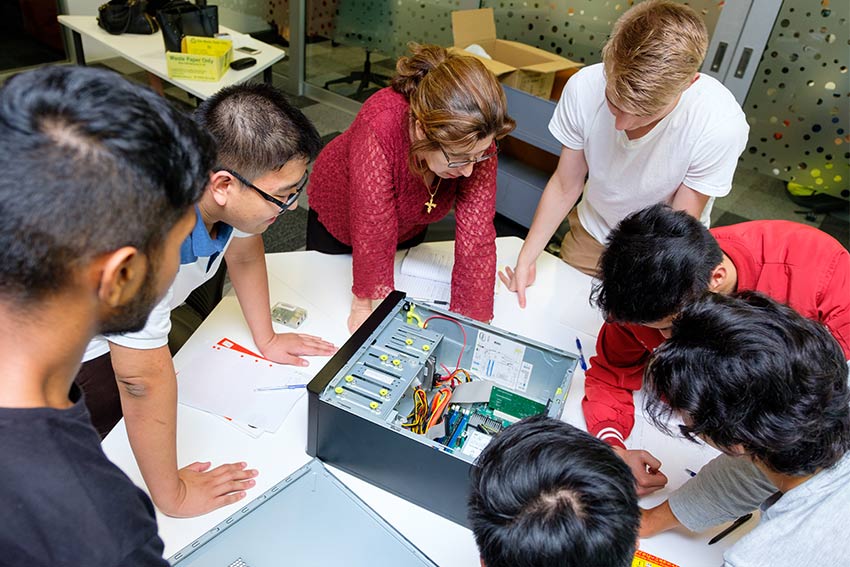
AI is changing our attitude towards, and use of ‘knowledge’. Universities are adapting as technologies develop. Our history of applied learning means AUT has always been far more than a place of knowledge transfer.
At AUT, our approach to learning, and proof of learning includes:
- Learn the thing, do the thing: AUT’s credentials are in applying knowledge – 89% of our bachelor’s graduates have a workplace experience, they have done the academic learning, and used it in real-world situations.
- Exposure to professional and clinical experiences. Many thousands of AUT students are in our dozens of programmes that meet professional, clinical or regulatory standards: from nurses and paramedics who have clinical placements, teachers who have teaching practicums or engineering students working towards globally accredited standards.
- Working with knowledge – and people: As AI develops, so too does the desire for ‘real’ experiences, the need to collaborate successfully, and the requirement to develop and hone judgement. These are not things an LLM can teach, but they are part of what a degree at AUT delivers.
- Assessments that mean something and show what students can do: Invigilated tests are not the answer to AI concerns. To graduate, AUT students must be able show how they can utilise their learning for real tasks, and staff must be able to observe and gather evidence of this learning. AUT has always used the assessment process to ensure students can demonstrate their learning through opportunities to investigate, work together, to analyse and critique.
- Assessing learning in the real-world: As New Zealand’s most modern university we have a huge range of assessments going well beyond the page or a digital environment and show our commitment to practice based and real-world learning. Assessments are in small localised face-to-face environments like studios (from architecture to design) and labs. They assess things students actually build - whether a computer science group project that meets the needs of a real client, an actual product a design student builds, or delivering a campaign for a real PR client as a communications student.
Is it still worth investing in a degree?
Yes. Going to university provides learning opportunities and experiences that go far beyond what an algorithm can provide. At AUT skills such as collaboration, critical thinking, creativity are baked into learning. Chances to apply learning in real-world situations, and to develop local and international networks all mean investing in a degree adds up.
How can you be sure students know their stuff?
Our focus at AUT has always been on students demonstrating their learning, not simply remembering facts in an exam setting. In the AI era AUT is refining our approach and using ‘Points of Observation of Learning’ (POOLs). Using POOLs, teachers and academics can see evidence of students’ ability to take what they have learned and use this information.
Does AUT still have invigilated assessments?
Yes, because sometimes it is essential for students to “think on their feet”, demonstrate independent learning and perform without access to AI. Depending on their programme, students may undertake clinical examinations, perform live demonstrations of technical skills, verbally explain their critical reasoning, and make decisions in real-time scenarios. These assessments sit alongside other ways students can demonstrate and apply their learning.
What about take-home assessments? Can’t students just use AI to write them?
Take-home assessments are important because that’s where skills and values such as relationship-building, judgement and curiosity can be developed and demonstrated. At AUT we have designed a model called Points of Observation of Learning (POOLs). POOLs make student thinking and learning visible, they put more emphasis on the process of putting an assessment together, rather than simply on the final product.
Does AUT include assessments in real-world settings?
Yes. Our graduates display the power of the knowledge they learned, and assessments are aligned with industry or professional - as well as academic - expectations. While studying, students have achieved real things, often while being assessed. Nursing students might have helped save lives, midwives delivered babies, teachers taught a classroom of students, computer scientists worked with a software client, communication students helped a small business. And all our graduates have worked in teams with other people, to deliver an outcome.
Across the university assessments are incredibly diverse:
- As New Zealand's largest health science university, we know that every year thousands of students have undertaken OSCE’s: Objective Structured Clinical Examination: these are practical tests used in almost all of the13 regulated health professions we teach, like paramedicine and nursing.
- Design, hospitality and other students work at digital and analogue interfaces to produce things as different as garments they have sewn, models of spaces and buildings, prototypes of products, chemicals and meals.
- Communication students are already contributing to actual news broadcasts on TVNZ.
- Students are working with robots, on drones, and other forms of physical AI as part of the learning and their assessment.
- To learn first-hand about how algorithms shape what we see and hear about the world via digital media, students in a global politics course deliberately change their online search terms, taking “before” and “after” screenshots to see the impact on their social media feeds. They can put these insights to use to become smart cultural navigators and more effective influencers for a better world.
- Students in Education use generative AI or social media to help them learn a skill that they are keen to develop. They document their interactions and use their own experience to turn theories of learning into practical action.
- In Engineering (ENME603 Fluid Mechanics), students document their learning through weekly learning journal entries. Students’ written submission explicitly demonstrates how the concepts encountered throughout the semester form the foundation for solving a complex, multi-part problem. The submission draws on – and explicitly cites – evidence captured in the learning journal, to support the claims and insights presented in the solutions.
- In ARCH810 (Advanced Topics in Architecture) – a self-directed course intended to help students develop skills or knowledge in a specific area of interest – students produce an "artefact" that is justified by a research question or design problem. Students document their planning and tracking progress using an interactive digital whiteboard (e.g., Miro / Lucid). Staff feedback and comments, as well as students’ responses to these, are time-stamped to provide a clear trail of development.