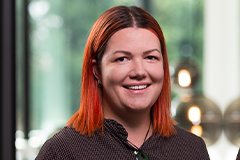
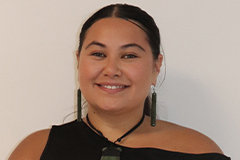
Tracy Murphy
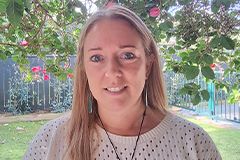
Clinical and Academic Lead, Health New Zealand | Te Whatu Ora – Te Matau a Māui Hawke's Bay, Hastings
Doctor of Health Science
Dr Tracy Murphy had been working in leadership roles for some time when she decided to undertake AUT’s Doctor of Health Science. While she had always planned to return to study, she says she wasn’t immediately sure what that would look like.
“I had some unanswered questions. I was always planning on doing some more study, but I wasn’t entirely sure what that was going to be. The Doctor of Health Science came highly recommended, was clinically relevant and looked like it was achievable with full-time work. I could see that it was going to enable me to focus on the areas that I was particularly interested in.”
With a background in occupational therapy, Tracy was no longer working clinically at the time and was feeling increasingly frustrated in a management-heavy role.
“The role I was in was very paperwork-heavy and task-focused, rather than supporting people to do their job really well or changing services to give patients the best care they could get.”
Focusing on Māori clinical leadership
Tracy’s whakapapa and leadership experience strongly influenced the direction of her doctoral research.
“I was particularly interested in Māori clinical leadership. I was observing some things that I didn’t see non-Māori leaders recognising. One of those things was that many of the Māori clinicians I was working with were taking on unpaid leadership roles, such as educating people around them on te reo Māori or tikanga in a clinical setting. Most of the time it was because they wanted to make health services better for Māori. I wanted to elevate the voices of Māori clinical leaders, but also record them in a way that could be shared with non Māori leaders, to make a difference for Māori clinicians on the ground.”
Since completing her doctorate, Tracy says the Doctor of Health Science has had a direct impact on her leadership opportunities and influence.
“Following organisational change within Health New Zealand, I moved into my current role as clinical and academic lead within a health equity team. The role required a doctoral-level qualification as well as research and equity-based experience. I wouldn't be in the role without my doctoral degree. I’m also co-chair of the Occupational Therapy Board and until 2025 was co-chair for the National Stroke Network. It’s just opened a whole lot of doors for me, and I’ve had more opportunities to broaden my network and my connections with people across Aotearoa.
“I’ve enjoyed the connections I’ve built with the Māori leaders in my research – that opportunity by itself was my absolute favourite part of my research and I've continually felt so supported by them. There are opportunities arising for me now to pay their kindness forward and support and awhi new Māori researchers who are coming through.”
Advice for other students
Having completed her Doctor of Health Science in 2024, Tracy has some great advice for other students.
“Make sure you’re passionate about your research topic. That was one of the things that kept me going. It took me an entire year to come up with the question that I really wanted to answer, but I was very interested in the research and that got me through the study, the early mornings and the writing.”
She is proud of finishing her doctorate in just over three years but admits that this achievement required a lot of sacrifices.
“There were some very early mornings and not a lot of socialising. I've got an 11-year-old and a 13-year-old, so completing my degree was pretty much pure stubbornness. I didn't want to drag it out, partly because I couldn't justify spending the money to take longer and partly because I didn’t want to take more time away from family. It was better for me to just put my head down and do it, and then not have to worry about it. I really appreciated the flexibility of the programme.”