Georgina Guild
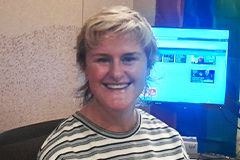
Doctor of Education student
Georgina Guild chose the Doctor of Education at AUT because she wanted to teach at level 8 and above in tertiary education, and the timing felt right to pursue doctoral study.
“I chose AUT specifically because it offers a format 3 doctorate, which combines a creative output with an exegesis. I particularly appreciate that both components carry equal weight, as the opportunity to undertake creative research appeals to me far more than writing a traditional thesis.”
In her studies so far, she has particularly appreciated the structure of the programme, the supportive learning environment and the freedom to explore her ideas.
“Our lecturers, who are themselves creative practitioners, actively encourage us to explore our ideas. I suspect that in a more conventional doctoral programme, I might have been encouraged to rein things in a little. Here, however, it feels as though nothing is off the table, which I find both energising and liberating. One of the most unexpected aspects of this journey has been how well I’ve achieved academically. I genuinely didn’t anticipate this, and it has given me a growing sense of confidence in what I might be capable of. Having an abstract accepted for presentation at the 2026 Gender and Education Association Conference has been another significant milestone. It feels particularly meaningful to have an opportunity to share research that is still emerging, but that I’m becoming increasingly excited about.”
Rethinking academic life
Georgina’s doctoral research explores how academic life shapes who we become, and whether there might be different ways of thinking, knowing and being within the academy.
“The current working title for my inquiry is (Un)becoming with the Academy: Performance and Possibilities for Thinking, Knowing and Becoming Otherwise. My research explores how the academy shapes who we become as academics through its expectations, relationships, technologies and power, and whether we might imagine different ways of being within it. Working within a postqualitative approach, I plan to use theatrical performance and satire to question the contradictions and absurdities of academic life.”
As part of her research, she is also developing a participatory technique she calls somatic sprawling.
“Somatic sprawling invites audiences to engage physically and creatively with materials and one another, becoming part of the unfolding performance. Rather than setting out to achieve a particular outcome, I’m curious about what these encounters might provoke, unsettle or make possible, and how we might begin to think, know and become differently together.”
Advice for other students
Expecting to complete her studies in 2031, Georgina has some great advice for other students who are considering the Doctor of Education.
“You do need to set aside regular time each week for study, so organisation and commitment are important. But my biggest piece of advice would be to trust yourself, especially when you feel like you have no idea what you're doing (which happens to me quite often!). You don't need to have everything figured out. Just keep moving, keep reading, thinking, talking and writing. Even when it feels like you're going nowhere, something is happening.”
She would highly recommend the programme to others.
“I value how the programme embraces creativity and challenges conventional ideas about what constitutes knowledge. The learning environment is supportive and provides space where unconventional ideas are welcomed and thoughtfully explored rather than dismissed.”
Related to this story


This page was last updated on 14 Nov 2026.