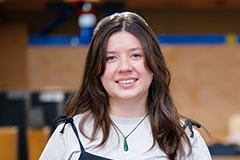
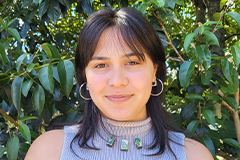
Caleb Jerome

Professional Dancer & Creative, Los Angeles, USA
Bachelor of Design in Communication Design
Caleb Jerome – who came to AUT to study a Bachelor of Design in Communication Design – has always been a multidisciplinary creative.
“Growing up in Christchurch, I was a dancer and choreographer who was also designing merch and media for local New Zealand artists and clothing brands. I didn’t yet have a clear picture of where these disciplines would lead, but I knew I wanted to communicate, and I saw the entertainment industry as the space to do it. Moving to Auckland was the natural next step, and AUT’s reputation as one of New Zealand’s most respected universities made it the clear choice. It also gave me access to some of the best dancers in the country to train alongside.”
It’s a decision he certainly hasn’t regretted, and he considers the final year of his degree the highlight of his AUT experience.
“My final-year project was self-led practice that gave me the freedom to explore the convergence of design and dance as disciplines. AUT provided access to resources, tools and mediums I wouldn’t otherwise have had, and that freedom to experiment was where my most significant creative development happened. It was also the year I began seriously interrogating my own identity as a creative – who I am, where I come from and what I have to offer.
“At the conclusion of my studies I received the Purple Pin for my exegesis, The Sampled Self: Investigating the Complexities of Identity Formation Through Cultural Sampling. This research took the form of a practice-led autoethnographic project examining how a postmodern identity can be communicated through design. Drawing on philosophy, psychology, music and dance, the project explored how different cultural references and disciplines are ‘sampled’ to form a sense of self, and how that self can find expression through a multidisciplinary design artefact. The physical output was a piece of CD packaging: a layered visual narrative built from motion, photography, typography and three-dimensional design.”
Shaping his creative journey
For Caleb, there was one AUT staff member who had a particular impact on his journey as a creative.
“Associate Professor Marcos Mortensen Steagall was my lecturer and supervisor in my final year, and his influence on my development as a creative was significant. When my first opportunity to tour internationally as a professional dancer arrived – performing for Jolin Tsai, one of Asia’s most iconic recording artists – Marcos didn’t ask me to choose between the tour and my studies. He encouraged me to find where the two intersected, and to let that experience inform my design practice and my voice as a designer. He challenged my thinking across philosophy, psychology, dance and design, pushed me to draw on what had inspired me since childhood – music, pop culture, identity – and demanded a depth of rigour I didn’t know I was capable of. He saw potential in me and shaped my final project into something I couldn’t have produced without his guidance. Those conversations fundamentally changed how I understand my own creative practice.”
He has some great advice for other students thinking about studying art and design.
“Throw paint at the wall. Dip your toes into as many things as you can, not because you’ll love all of them but because you never know which discipline will change the way you see the one you do love. The thing that seems unrelated to your main focus might be exactly what gives you a unique point of view in your field. I knew I loved dance. Studying design didn’t distract from that – it deepened it, gave me language for it, and opened doors I didn’t know existed. Trust the intersections. That’s usually where the most original work lives.”
Creativity across disciplines
After graduating from AUT in 2024, Caleb now has a career that spans multiple disciplines, intersecting exactly the way his research at AUT explored.
“As a professional dancer, I am currently on my third tour with Jolin Tsai, performing to 80,000+ people a night across different cities. In parallel, I work as a freelance graphic designer and brand strategist, taking clients from initial brand strategy through to design execution and rollout, for everyone from small businesses to established creative companies. One of the advantages of operating across both worlds is that my performance career puts me in rooms with other industry professionals who often need design services – the two practices genuinely sustain each other. I’ve also contributed to Paris Fashion Week and am currently preparing for New York Fashion Week, where I work as a stylist and contracted jewellery designer.
“What I enjoy most is that no two days look the same. I can be performing on a stadium tour one week and developing a brand identity for a client the next. Studying design gave me an aesthetic eye and a level of taste I now trust completely. Dance lives in a three-dimensional space – alongside lighting, staging, styling, and concept – and understanding how all of those elements work together as a visual world means that I can be more intentional about how my movement sits within that. It’s not that I’m designing any of those elements; it’s that I understand the world I’m performing inside, and that changes how I perform in it.”
He didn’t anticipate how much studying design would sharpen him as a performer.
“It gave me an aesthetic eye and an understanding of the three-dimensional space that dance lives in – how movement sits within a broader visual concept that includes lighting, staging, styling and set design. Understanding how they work together means I can make better creative decisions about how I move within that world and how my performance contributes to it. AUT gave me the knowledge and confidence to trust that instinct. That’s what The Sampled Self was really about, and it’s what I’ve built my career on.”