Third year running for AUT NASA interns
Life on Mars has captured the attention of the wider public for centuries from HG Wells to David Bowie.
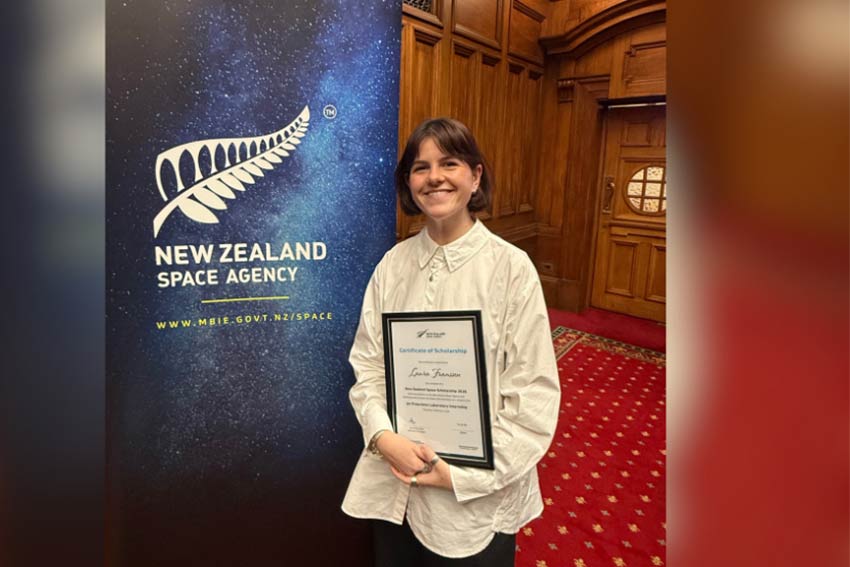
Now AUT award-winning teaching assistant and Microbiology PhD student Laura Franssen from the School of Science is joining their ranks. She is about to head to NASA – the third AUT student in a row to have been awarded a three-month internship at the NASA Jet Propulsion Laboratory in California through MBIE’s and New Zealand Space Agency’s New Zealand Space Scholarship.
She is the first microbiology researcher to be awarded the scholarship.
Her work has something of a Project Hail Mary angle as the NASA team will be using simulated Martian and Europa environments to look at viruses that infect bacteria (known as bacteriophages).
While in California, Laura will work on an astrovirology project investigating how synthetic brines and ice conditions affect bacteriophages as they freeze and thaw. These findings will help inform sampling conditions for future life detection missions and demonstrate the use of viruses as evidence of life.
Laura explains: “The presence of Martian permafrost, seasonal brine formation, and liquid water underneath ice sheets of moons orbiting Jupiter, Saturn, and Uranus indicate possible ‘habitable’ areas for past or present life systems.
“Earth’s waters can contain ten times more phages than bacterial cells. Therefore, if life was or is present on these potentially habitable planets and moons, we’d expect to see the presence of bacteriophages too.”
Laura grew up near Dannevirke and had limited access to science resources through school but her parents encouraged her interest in space from a young age.
“While I'm sure eight-year-old me didn't know what astrobiology was, I knew I was fascinated by what existed beyond the big dark sky above us.
“I was initially drawn to microbiology, which I later studied at AUT, through an interest in molecular genetics. My high school teacher at St Peter's College in Palmerston North recognised that interest and recommended AUT as a place where I could continue pursuing science.
“At AUT, I met Professor Donnabella Lacap-Bugler. She was the course leader for my first-year foundational microbiology paper, and one lecture in particular changed the direction of my career. She spoke about life in extreme environments and how prokaryotic (single-cell) organisms can survive conditions that larger, more complex life forms, including humans, cannot tolerate. She finished by discussing if microbial life can survive environments with severe water limitations, extreme pressures, and intense cold here on Earth, why couldn't it exist elsewhere in the universe? From that moment, I was hooked.”
Laura continued working with Donnabella throughout her undergraduate and postgraduate studies, gradually moving closer to her long-held dream of studying extreme environments on Earth to better understand the potential for life beyond our planet.
“That journey eventually led me to my PhD research, which investigates bacterial life in the Atacama Desert of northern Chile. The Atacama is widely recognised as one of the best terrestrial analogues for Mars, with both environments sharing similarities in their long-term climatic conditions. By studying microbial life in this desert, we can help inform future life-detection strategies for planetary exploration while also improving our understanding of how life adapts and evolves under extreme conditions on Earth.”
This year was the third time she’d applied for the New Zealand Space Agency scholarship. “As they say, third time's the charm and the experiences I gained along the way helped prepare me for this internship.
“I am incredibly proud to represent both New Zealand and AUT through this opportunity. Whatever comes next, I will continue chasing the dream that first began under Aotearoa's rural night sky."
When she returns, Laura will graduate from AUT with a PhD in Microbiology in December.
Donnabella has long-standing collaborations with the NASA Ames Research Centre. Her research and Laura’s look at using analogue environments here on Earth to better understand and improve the detection of life on Mars.
"So it’s not the engineering and building of rovers, but about analysing samples for possible detection of life outside Earth or how we can possibly make other planets habitable with the help of micro-organisms,” she says.
Useful Links
- Bachelor of Science Degree - AUT
- 2026 Space Scholarship recipients | Ministry of Business, Innovation & Employment
- Student receives NZ Space Scholarship - AUT News - AUT
- New Zealand Space Scholarship | Ministry of Business, Innovation & Employment
- Donnabella Lacap-Bugler | Mōku | About | Auckland University of Technology
AUT supports the role our academics play as critic and conscience of society, as set out by the Education and Training Act 2020. Our approach to academic freedom and freedom of expression is set out in our Charter of Academic Freedom, which was developed and endorsed by the AUT academic community.