The CRL will change Aucklanders’ lives
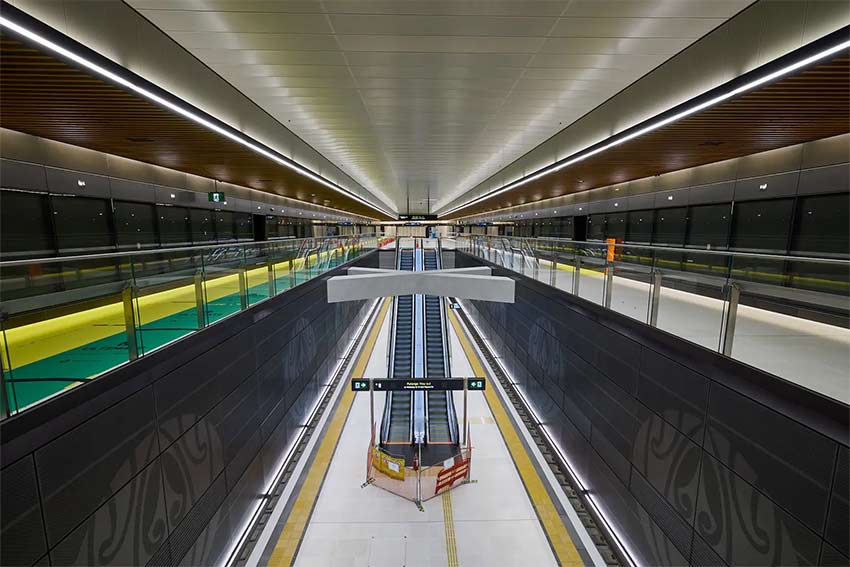
Dr Erica Hinckson, AUT Professor of Physical Activity and Urban Health, says the opening of the CRL is a major transport milestone for Auckland. It is a significant investment in the kind of city we want Auckland to become: more connected, more accessible and less dependent on private cars.
From a public health and climate perspective, public transport matters because it supports health and wellbeing while contributing to efforts to reduce transport emissions. Almost every public transport journey begins and ends with walking, wheeling or cycling. Frequent public transport services that are reliable and well-connected can make physical activity part of everyday life while also helping to reduce traffic congestion, air pollution and emissions.
According to Auckland Transport, the City Rail Link (CRL) was designed to provide faster journeys, new direct connections and trains every four to five minutes through the city centre at peak times. These changes could make public transport a genuinely practical choice for many more Aucklanders. However, the rail link alone will not deliver these benefits. Its success will depend on what happens around it: safe, shaded and pleasant walking and cycling routes to stations, affordable fares, reliable connecting buses and accessible station design, among other factors.
The City Rail Link gives Auckland an extraordinary piece of infrastructure, and I hope this is only the beginning. It needs to be treated as the foundation for healthier, more equitable and more sustainable neighbourhoods across Auckland. The key is to take an integrated approach to connect transport, land use, public health, and climate resilience. This investment has the potential to reshape how Aucklanders move through and experience their city for generations, while caring for the environment and its people.
Professor Ali Ghaffarian Hoseini, Head of AUT’s School of Future Environments, says the City Rail Link is often described as a transport project, but that undersells it. What opens on 13 September is really a change in the geometry of Auckland. Through turning Britomart from a dead end into a through station and threading 3.45 kilometres of twin tunnels under the city centre, the CRL roughly doubles the reach of the rail network without laying a single kilometre of new suburban track. In the language of urban science, it compresses time and distance across the city, and cities that compress time and distance well are the ones that thrive. When a trip from Panmure to Karangahape Road drops by fourteen minutes, that is not a marginal gain. It changes where people can plausibly live, work, study and meet, which is the deepest benefit any piece of urban infrastructure can offer.
From a future environments perspective, the stations themselves deserve as much attention as the tunnels. Te Waihorotiu is expected to become the busiest station in the country, and together with Karanga a Hape and Maungawhau, it gives Auckland something it has never had: underground civic rooms of international quality, designed with mana whenua and layered with cultural narrative. I believe these are anchors around which a denser, more walkable and more energy efficient city centre can organise itself. Every rider the CRL attracts is a car trip the road network no longer has to absorb, so this is also one of the most significant decarbonisation and resilience investments Auckland has made in a generation.
At the same time, a tunnel alone does not transform a city, and it would be a mistake to treat opening day as the finish line. The CRL is a necessary condition for a better Auckland, not a sufficient one. Its full value has to be earned in the years that follow: through genuine intensification and quality development around the stations, through a feeder bus network and a legacy rail system maintained to the same standard as the new core, and through station precincts that are activated and cared for so they feel safe and alive at nine in the evening, not only at nine in the morning. International experience is clear that the cities which extract the most from investments like this are the ones that plan deliberately for what comes after the ribbon is cut.
What excites me most as a researcher is that from September, Auckland effectively becomes a living laboratory for the next generation of intelligent urban mobility. We will be able to observe, in real time and at scale, how travel behaviour, development patterns and street life reorganise around a step change in accessibility, and that evidence should directly shape how we design the smart, sustainable urban environments New Zealand needs next. Few cities anywhere get to study a moment like this in their own backyard. Auckland should make the most of it, both as a place to live and as a source of knowledge the rest of the country can build on.
AUT supports the role our academics play as critic and conscience of society, as set out by the Education and Training Act 2020.
Our approach to academic freedom and freedom of expression is set out in our Charter of Academic Freedom which was developed and endorsed by the AUT academic community.