Staging the ancient Greeks in our crisis era
The city of Troy, Agamemnon, Odysseus and Circe are household names again. For her creative practice doctorate at AUT, Dr Holly Luton looked at why the ancient Greeks are still so relevant, more than 2500 years on.
While perusing the shelves of Unity Books, I took notice of a young woman behind me. She politely asked the staff if they stocked Emily Wilson’s translation of the Odyssey. Another asked for Madeline Miller’s novel, Circe. With Christopher Nolan’s blockbuster film, The Odyssey, in the cultural zeitgeist, the ancient Greeks are evidently still pulling crowds two-and-a-half millennia on. The age-old question is reignited: why are modern audiences still captivated by the myths and stories of the ancient Greeks?
As a theatre director, dramaturg and researcher, I have long been fascinated by Greek tragedy, a form rarely staged professionally in Aotearoa, and its powerful capacity to provoke reflection on war, refugees, the subjection of women, political power, trauma, survival, and resilience. Through my creative practice doctorate, I directed two productions, Euripides’ Women of Troy and Aeschylus’ Agamemnon, inviting actors and audiences to reflect on what the ancient Greeks might have to say for today in this turbulent era.
As the Covid-19 pandemic forced the closure of performance venues across the world, I became interested in how crisis could be a creative catalyst for theatre-making, and, significantly, the kinds of plays that might resonate with the themes of our lived experiences.
I turned to the ancient Greeks, whose culture and history have fascinated me since childhood museum excursions. Staging Sophocles’ Antigone in an isolated Perspex box—as a practical response and dramatic metaphor for our collective lockdown experience—made the play’s enduring questions feel strikingly immediate. What does a leader owe their people in times of crisis? How do we honour the dead during a public health emergency? Where is the line between public safety and individual conscience?
Moving into my doctoral research in 2022, alongside an incessantly volatile era, made the Greek tragedies impossible to ignore—images of American troops evacuating Kabul, thousands of Ukrainian refugees in a mass exodus during Putin’s ongoing invasion, and the continued systematic massacre of Palestinian people in Gaza.
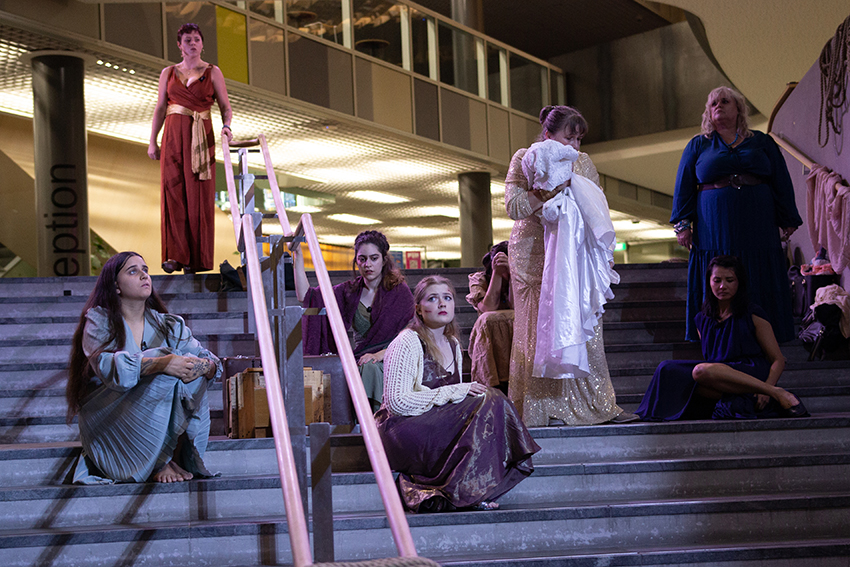
Staging Euripides’ Women of Troy, a tragedy regarded as the greatest anti-war play, I transformed the concrete grand staircase of AUT's Sir Paul Reeves building into the ruined city of Troy. Towering balconies became battlements from which the child Astyanax was thrown to his death, while the stark modern concrete and steel echoed contemporary images of bombed cities. Euripides, himself a career soldier during the Peloponnesian War, invited his contemporary audiences to consider the brutal slaughter of women and children during the Athenian invasion of Melos. Rather than presenting the Trojan War as distant mythology, my production invited audiences to recognise the enduring human cost of conflict and to hear the voices of women, so often lost behind our current headlines and statistics.

My final production of Aeschylus’ Agamemnon explored cycles of violence and inherited trauma, dancing the dramatic and violent climax of Agamemnon’s murder by his axe-wielding wife, Clytemnestra, set to the punk rock feminine anthem of Xray Specs’ Oh Bondage! Up Yours, complete with a bathtub on wheels.
In a dramatic turn, the production itself became a site of bureaucratic, pragmatic, and personal health crises, forcing its cancellation during dress rehearsals. While heartbreaking, the experience serendipitously compelled me to reflect on my central research questions; whether crisis can always be a site of creative generation and how it might help us respond, adapt, and find meaning within uncertainty.
Through these productions and reflective, collaborative practice, the research found that Greek tragedy offers a powerful framework for making sense of contemporary crises, and that knowledge can be generated, mediated, and disseminated not only through written scholarship but also through embodied creative practice itself.
These plays do not simply preserve stories from the past but might also offer an opportunity to grapple with difficult experiences of love, rage, grief, and resilience.
They are dramatic, visceral, inspirational, challenging, critical, urgent, and otherworldly, and yet they speak to our own lived experiences. In a world increasingly shaped by instability, they might also serve as a reminder that generations before us wrestled with uncertainty, injustice, and loss. Perhaps that is why, 2500 years on, people are still reaching for Homer, Sophocles, Euripides, and Aeschylus on the shelves of our bookshops and buying tickets for cinema screenings and theatrical productions.
This article was written by Holly Luton about her research A Director's Process for Staging Ancient Greek Tragedy in an Era of Crisis—Fragility, Resilience, Resonance. It was originally published in the Sunday Star-Times Brainwaves feature. Read the original on The Post .
Useful links
AUT supports the role our academics play as critic and conscience of society, as set out by the Education and Training Act 2020.
Our approach to academic freedom and freedom of expression is set out in our Charter of Academic Freedom which was developed and endorsed by the AUT academic community.