Saving the art of Tukutuku
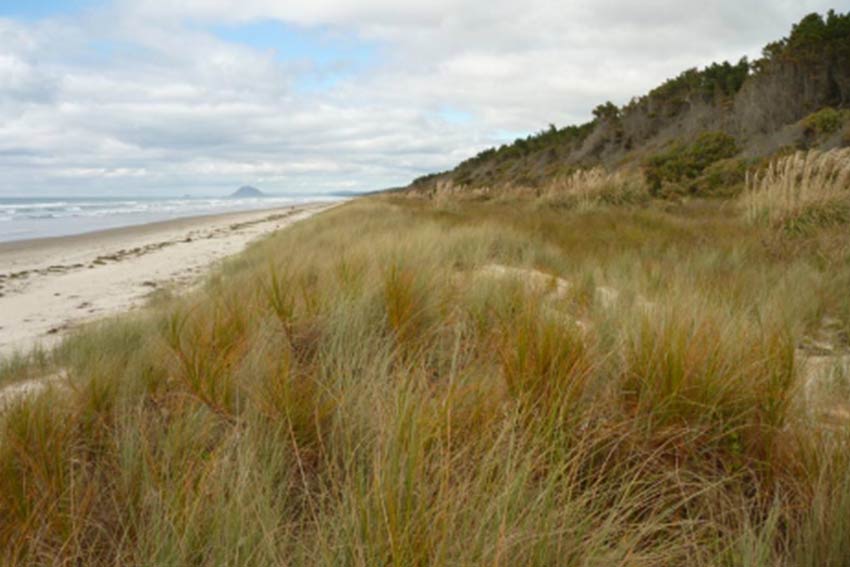
Two AUT research networks have joined forces to help save the traditional Māori art of tukutuku.
Te Ranga Tukutuku AUT Māori Research Network and Te Whare Tūroa AUT Regenerative Environments Research Network have received nearly $300,000 of research funding from the Coastal People: Southern Skies Centre of Research Excellence.
Their collaborative project is called ‘Ngā Taonga Tuku Iho – The restoration of pīngao (pīkao) to save ’.
The funding will support a two-and-a-half-year research programme running from July 2026 to November 2028.
The Ngā Taonga Tuku Iho project aims to restore the mauri (life principle / force) of coastal ecosystems by bringing weaving, language, and ecology together.
It is focussed on pīngao (Ficinia spiralis – also known as pīkao), a golden-leaved grass-like plant (sedge) that grows on the active sand dunes of Aotearoa New Zealand.
Project lead Professor Tania Ka’ai (Ngāti Porou, Ngāi Tahu, native Hawaiian, Cook Island Māori, Sāmoan), from AUT’s Te Ipukarea Institute for Indigenous Knowledge, says the project responds directly to priorities raised by weavers and iwi.
“We wanted to help address the concerns raised in recent wānanga about the decline of pīngao and the impacts this has on cultural practices, language use and wellbeing. It is an honour to work with expert weavers - they hold huge amounts of knowledge and deep connections to community.” says Professor Ka’ai.
Despite decades of coastal restoration work by many different groups, pīngao (pīkao) populations are in decline. It is a native sand-binding plant with golden-orange leaves that was once widespread on active coastal dunes throughout Aotearoa. It is now classified as “At Risk – Declining” under the New Zealand Threat Classification System.
Its potential loss is not only an ecological concern: pīngao is one of the primary materials used in tukutuku - the ornamental lattice work found in wharenui - which encodes whakapapa, relationships, and cultural identity. If pīngao disappears, so does a foundational element of this living art form.
“We are thrilled to have this opportunity to help protect and raise awareness about pīngao because it really is a national treasure. If we don’t work together to understand how to save pīngao we could end up with only plastic and particle board to adorn our wharenui – and that would be a tragedy.” says Professor Ka’ai.
This project will produce the first national map of pīngao populations in more than 30 years. Project ecologist Professor Hannah Buckley says this map will be a critical contribution to pīngao conservation.
“It’s very important to understand the distribution of pīngao. We will combine ecological field surveys, existing datasets, and the knowledge of weaving communities to identify where pīngao persists, where it has been lost, and which sites hold cultural significance,” says Professor Buckley.
The Ngā Taonga Tuku Iho project is comprised of experts from many fields including Māori and Pacific researchers, weavers from the Raukura Weavers Collective and scientists with expertise in dune ecology and geomorphology, plant ecology and applied geospatial science at both AUT and the University of Otago.
The project also extends beyond Aotearoa, with a Pacific knowledge exchange component connecting researchers and weavers in the Cook Islands, where similar fibre plants, weaving traditions, and pressures exist alongside rich knowledge of adaptation and stewardship.
The project uses kaupapa Māori methodologies including wānanga, hui, oral histories, and participatory storytelling alongside Pacific frameworks of talanoa and ‘uipa’anga.
“Oral narratives contain vast amounts of knowledge, and they also add meaning and feeling to this kind of work. I love that they are passed down intergenerationally, and I hope this work can become part of the story of pīngao that is shared beyond our time,” says Professor Ka’ai.
Documentation of mātauranga, language associated with pīngao and coastal dune environments, and knowledge of gathering and cultivation practices will be developed in te reo Māori and English. All knowledge will remain under the authority of knowledge holders, guided by Indigenous data sovereignty principles.
Useful Links
- Te Ranga Tukutuku
- Te Whare Tūroa AUT Regenerative Environments Research Network
- Professor Tania Ka’ai
- Professor Hannah Buckley
- Coastal People: Southern Skies Centre of Research Excellence.
AUT supports the role our academics play as critic and conscience of society, as set out by the Education and Training Act 2020. Our approach to academic freedom and freedom of expression is set out in our Charter of Academic Freedom, which was developed and endorsed by the AUT academic community.