Q&A: Journalism Matters
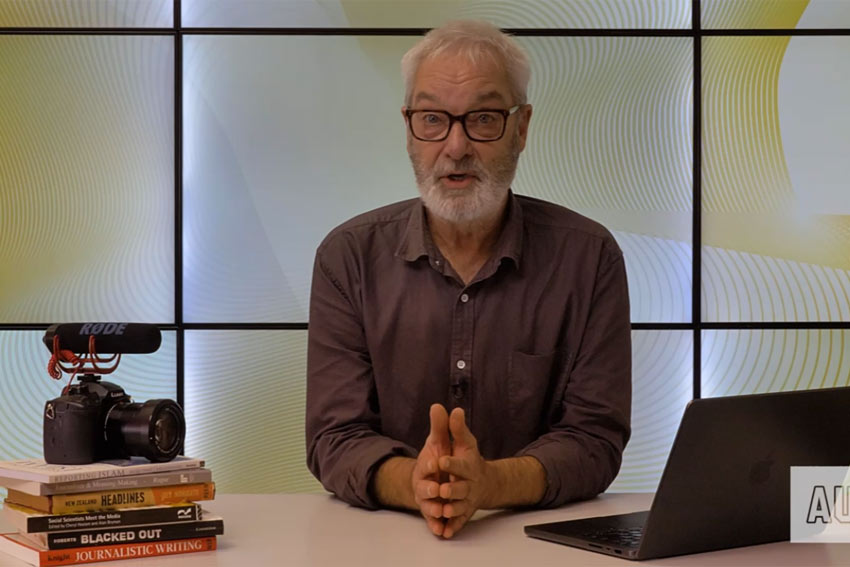
Why does journalism matter in a democracy? Dr Greg Treadwell tackles trust, public funding, media criticism and the changing news landscape.
Q: Why does journalism matter, and how do journalists hold the powerful to account?
Journalists sometimes expose wrongdoing that leads to legal consequences, but most often they hold the powerful to account simply by letting the public know what those in positions of power are doing and how they are using the authority that a democratic society has entrusted to them.
It is not always dramatic or investigative journalism that performs this role. Much of the time it is the day-to-day reporting that shines a light on what is happening in society and helps citizens stay informed about decisions that affect their lives.
Q: Why do we hear so much criticism now of the mainstream media? What does that mean?
Historically, the media was often criticised by the political left for being too closely aligned with institutions and established power structures. Today, criticism more commonly comes from the political right, which argues the media has become too progressive. These criticisms extend right up to members of New Zealand's Cabinet.
The term "mainstream media" has become increasingly politicised, particularly since the Covid pandemic. A more useful term may be "legacy media". The key question is whether the media itself has changed significantly, or whether attacks on the media reflect broader changes in the political landscape.
Legacy news organisations remain one of the few places where people with differing viewpoints can engage with a shared set of facts and participate in productive conversations. Highly partisan websites often do not provide the same environment.
That is not to say the mainstream media is beyond criticism. It has historically been criticised for not doing enough to challenge mainstream assumptions, particularly around issues such as culture and race. While there is still work to do, journalism has become more aware of and responsive to these issues than it was in the past.
Legacy media is vulnerable to critique, but a world without it would risk becoming a free-for-all information environment. While voices at the political edges can introduce important ideas, mainstream news organisations help provide a common foundation that anchors public discussion.
Q: Does government funding of media mean public broadcasters are in the Government’s pocket?
Absolutely not.
A healthy democracy such as Aotearoa New Zealand benefits from having both publicly owned and privately owned media organisations. Public funding helps ensure there is a strong foundation for news and information rather than leaving everything to market forces.
In New Zealand, Radio New Zealand is the most prominent example of publicly funded media. Government funding does not mean journalists are producing stories that the government wants them to write. In fact, that accusation strikes at the heart of journalistic independence and would be deeply confronting for many journalists.
A healthy democracy depends on a degree of tension and scepticism between public broadcasters and the state. Public funding is not the same thing as political control.
Q: Why do so many stories seem to be shared on lots of different news websites these days?
Story-sharing arrangements have become increasingly common across New Zealand media organisations. For example, Radio New Zealand shares stories with Stuff and other outlets, while other organisations distribute content through similar partnerships.
The intention has been to spread news more widely and ensure important reporting reaches as many people as possible. However, there has also been some unintended fallout. Some audiences have come to believe that news organisations are all working together and are therefore no longer independent.
Despite shared content, competition remains a vital part of journalism. Differences between news organisations are highly valuable and should not be overlooked. Journalists and media companies are still competing vigorously for stories, exclusives, and audience attention.
That competition is often what drives journalists to produce their best work, particularly when they are striving to break a story first.
Q: My local community Facebook group has the news faster than the media. Why is that?
It is important to distinguish between information and news.
Information often appears on social media before journalists become aware of it. That is now a normal part of the modern news environment, and many stories first emerge on social platforms.
However, information is not necessarily journalism. Journalism requires verification. When discussing news in a democratic sense, it refers to information that has been checked, confirmed, and assessed for its relevance to the public.
Something may appear on Facebook before it is reported by journalists, but it does not become journalism until it has been verified. A journalist's role is to determine whether the information is accurate and whether it matters to the public.
If you are unsure whether something is really news, ask whether it has been verified by a professional journalist whose job is to check its accuracy and relevance.
Q: What is your favourite news story of all time?
One of the most significant news stories ever reported is Watergate. The investigation fundamentally changed the relationship between journalism and political power and demonstrated the impact journalism can have in holding leaders accountable.
For anyone interested in learning more, the film All the President's Men provides an excellent introduction to the journalists and reporting that helped expose the scandal that contributed to the downfall of President Richard Nixon.
Among stories from my own career, one that stands out occurred when former United States President Bill Clinton visited Auckland for the APEC summit in 1999. At the time, there was considerable discussion about building bridges between people and communities.
During the summit, homeless people were moved out of central Auckland and many found themselves on Waiheke Island. After spending a cold night sleeping on the beach, some attended a local Catholic church where parishioners were celebrating a 60th wedding anniversary.
Initially there was uncertainty between the visitors and the congregation, but the atmosphere changed when one elderly parishioner simply asked whether they would like something to eat. From that point, connections formed and people from very different backgrounds shared food and conversation together.
Interviewing both the parishioners and members of the homeless community became the basis of a story about what it really means to build bridges. The irony of world leaders discussing bridge-building while ordinary people quietly demonstrated it in practice made the story especially meaningful.
The experience reinforced the idea that great journalism is not always about the biggest headlines. Often, it is about the stories that help readers see the world differently.
Q: Does it matter if we trust the media?
Trust in the media matters, but complete trust is not necessarily a good thing.
If a population trusted the media 100 percent of the time, it could suggest a lack of critical thinking. Citizens should approach news thoughtfully and critically, while also expecting accountability from media organisations.
What matters is not necessarily the absolute level of trust but whether trust is increasing, declining, or remaining stable over time.
In New Zealand, trust in news has fallen significantly in recent years. Current research suggests that decline may have stabilised, with signs that trust levels are no longer falling as rapidly.
There are many reasons for changes in trust. One factor has been the lasting impact of the Covid pandemic, which strained social relationships across society, including relationships between audiences and news organisations.
Q: Why should you pay for an online news subscription? News seems to be everywhere and mostly free.
Journalists deserve to be paid for their work.
The financial pressures facing news organisations mean many outlets cannot afford to employ enough journalists to provide the level of democratic journalism society needs. Well-funded newsrooms can produce not only daily reporting but also deeper investigations and more comprehensive analysis.
The news industry has faced a major financial crisis since the 1990s. If people believe journalism is not as strong as it once was, part of the reason may be that there are simply fewer resources available to support it.
Every subscription contributes to rebuilding the financial stability of news organisations and helps sustain quality journalism.
Q: Is journalism sustainable in a world where giant companies control nearly all the advertising?
This has become one of journalism's biggest challenges.
Advertising has funded news organisations for more than a century, but dependence on advertisers creates the risk that stories affecting those advertisers could come under pressure.
In practice, journalists generally resist that influence very strongly. Newsrooms place enormous value on editorial independence because credibility is essential to their success.
Journalists depend on public trust, and reporting that appears compromised or influenced by advertisers is usually identified and criticised quickly. Audiences are capable of recognising when journalism lacks integrity.
Q: What are journalistic ethics?
Journalistic ethics are the rules and principles that guide journalists in minimising harm while reporting on matters of public importance.
That does not mean harm never occurs. Journalism often involves difficult decisions, and there are times when stories that some people would prefer not to see published are nevertheless in the public interest.
Ethically, journalists are expected to choose the path that causes the least harm while still fulfilling their responsibility to inform the public.
Legacy media organisations operate under established codes of ethics. In New Zealand, members of the public can raise concerns through bodies such as the Broadcasting Standards Authority and the New Zealand Media Council if they believe journalists have acted unethically.
These frameworks help ensure journalism remains accountable to the public it serves.
Q: What advice would you give somebody wanting to be a journalist?
Devour the news.
Be deeply curious about what is happening in your life, your whānau, your community, your country, and the wider world. Care about people and care about what is happening around you.
Beyond that, get your apostrophes right.
Q: What role, if any, should AI have in reporting the news?
Artificial intelligence is already becoming part of modern journalism. It is being used to assist with research, organisation of content, and other newsroom functions.
The key issue is transparency. News organisations must be open about how AI is being used and ensure audiences understand the role it has played in producing content.
Most importantly, there should be no doubt that a human journalist remains responsible for the news being produced. Even if AI helps gather information or support production processes, accountability for journalism must remain with people.
Q: What is clickbait? And how is it different from regular news?
Clickbait refers to content that is designed to be so compelling that people feel almost unable to resist clicking on it.
However, not all click-worthy content is bad journalism. A highly engaging story about something important to a community can attract attention while still providing genuine value. For example, a story about the remarkable achievements of a mountain rescue dog might be irresistible to readers but still be legitimate news.
The real question is whether the content serves a public interest.
Human interest stories have always been part of journalism and add richness to public life. Problems arise when content attracts attention without offering meaningful information or relevance to the community.
If a story exists only to generate clicks and provides no genuine public value, it is simply clickbait.
AUT supports the role our academics play as critic and conscience of society, as set out by the Education and Training Act 2020.
Our approach to academic freedom and freedom of expression is set out in our Charter of Academic Freedom [PDF, 175.9 KB], which was developed and endorsed by the AUT academic community.