Q&A: Human Rights Matters
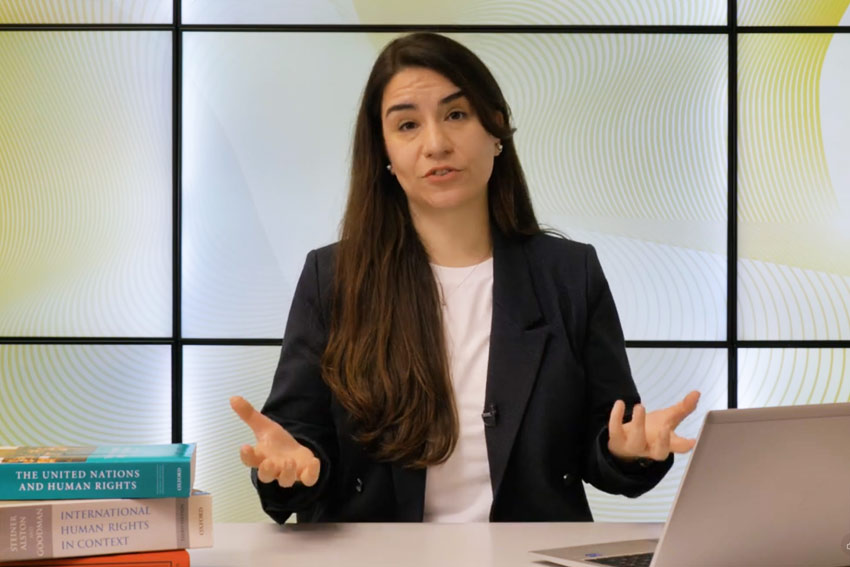
AUT law lecturer Lida Ayoubi on human rights, legal protections, global challenges and the possibility of new rights emerging in future.
Q: Is everyone equal when it comes to human rights, and does everyone have them?
Technically, yes. Everyone has the same human rights. The principle is equality and dignity for all. Equality does not, however, mean that everyone must be treated identically.
Everyone has the same human rights and is supposed to be equal before the law, with equal protection of the law. But circumstances in a person’s country or their personal situation may affect how they are treated. Rights are not absolute, and governments can restrict them for particular purposes, such as safety or public health.
Although everyone has the same rights, how people enjoy them and how they are applied can differ according to personal circumstances, country and, unfortunately, how committed a government is to treating everyone equally.
Q: What exactly are “human rights”?
There are two broad ways to answer this. One view is that human rights are natural rights: rights we are born with and have inherently by virtue of being human. On this view, these rights have always existed in some form, and governments do not need to recognise them for them to exist.
Another, more legalistic view is that rights exist because governments have recognised and written them down in constitutions, laws and other instruments.
Either way, human rights can be described as things we all need to live a good life: liberty, equality, safety, privacy, family, education, food and work, among other things. What counts as a good life can look very different depending on where a person lives and their culture. Defining and applying human rights has therefore always been a work in progress.
Q: What is the United Nations Universal Declaration of Human Rights, and why was it written?
The Universal Declaration of Human Rights, often referred to as the UDHR, is a shared promise about what every person deserves simply by being human. It was adopted in 1948, and every country in the world has endorsed it.
The declaration was created to help ensure that the atrocities of the two world wars, particularly the Second World War and the Holocaust, would never happen again. It was adopted by the countries that were members of the United Nations at the time. It became the source and foundation for the human rights treaties adopted subsequently, and is a cornerstone of modern human rights.
Q: If the UN Declaration of Human Rights was written in 1948, does it ever get updated?
The answer is both no and yes. The text of the Universal Declaration of Human Rights has never been updated and probably never will be. Declarations, unlike treaties, which are legally binding international instruments, are not meant to be changed under international law.
In another sense, however, the ideas in the UDHR have evolved. Subsequent human rights agreements have built on its spirit through new conventions on women’s rights, children’s rights and the rights of persons with disabilities. While the text has not changed, the ideas and rights in the declaration, and the way they are applied, continue to evolve and grow.
Q: How does New Zealand uphold the human rights of people in New Zealand?
New Zealand has been a leader in human rights, from being the first country to grant women the right to vote to being one of the original 50 member states of the United Nations and helping draft the Universal Declaration.
Domestically, people’s rights are protected by a number of laws. Important examples include the New Zealand Bill of Rights Act 1990 and the Human Rights Act 1993, which mainly protects equality and non-discrimination. Courts and bodies such as the Ombudsman, the Human Rights Commission, the Privacy Commissioner and the Health and Disability Commissioner, among many others, also help uphold human rights.
Q: Do some people have more human rights than others?
No. There is no VIP status or gold-level membership for human rights. Human rights belong to everyone; they are universal and should apply without discrimination.
However, how rights are applied can differ depending on people’s circumstances, and context matters. A disabled person has the same rights as everyone else, but in some contexts the law may require reasonable accommodations or adjustments, such as a wheelchair ramp. These enable the person to exercise the same rights effectively and fully.
Q: Are we living in a time when human rights are at their most vulnerable internationally?
It can feel that way in light of constant news about war, repression and democratic backsliding in many parts of the world. But that perception is also shaped by 24/7 global media coverage and access to social media, which make violence and injustice instantly visible in a way they were not before.
The current era is complex. New threats, such as digital surveillance and disinformation, challenge rights. At the same time, overall global levels of violence or loss of life have declined, and more groups, including women, Indigenous peoples and disabled people, now enjoy legal recognition.
Human rights are facing serious pressures, but they also have a stronger legal foundation than arguably at any other time in history. There is also more human rights education and self-advocacy today.
Q: How does New Zealand compare internationally on human rights?
There are many ways to measure this. Overall, New Zealand generally does well compared with other countries on criteria such as transparency, democratic processes, fair elections and low levels of corruption.
New Zealand still has work to do on economic, social and cultural rights, including issues such as affordable housing and inclusive education.
Q: Is everyone entitled to have their human rights protected? What about mass murderers and paedophiles?
Although it may feel counterintuitive, yes. Everyone has human rights, and those rights belong to everyone, no matter what they have done or who they are.
Rights are not absolute and can be restricted for a particular purpose, such as protecting the wider community. For example, someone convicted of a serious crime might temporarily lose their right to liberty, but retains basic rights to fair treatment, due process and dignity, as well as freedom from torture.
Q: Has the world made progress in ensuring human rights for all?
Yes. The world has made significant progress. Slavery was abolished, apartheid fell and women gained the right to vote, among other rights. More nations now protect LGBTQI, disability and Indigenous rights, and many countries have abolished the death penalty.
Much work remains, particularly on economic, social and cultural rights, because protecting them requires continuous effort and substantial resources. Things are not perfect, but the world has come a long way in protecting human rights. The hope is that humanity will continue to move forward and that the long arc will continue to bend towards equality and freedom.
Q: Could there be new human rights in the future?
Absolutely. Human rights and their meaning evolve with the times. As new technologies such as AI, data tracking and brain chips transform our lives, new rights may emerge to protect privacy, identity and even our thoughts.
While past generations largely fought for equality, the next fight might be for our rights online, in outer space and beyond.
Useful links
- Senior Lecturer Lida Ayoubi's academic profile
- United Nations Universal Declaration of Human Rights
- New Zealand Human Rights Commission
AUT supports the role our academics play as critic and conscience of society, as set out by the Education and Training Act 2020.
Our approach to academic freedom and freedom of expression is set out in our Charter of Academic Freedom which was developed and endorsed by the AUT academic community.