Kānuka extract impacts cancer cells
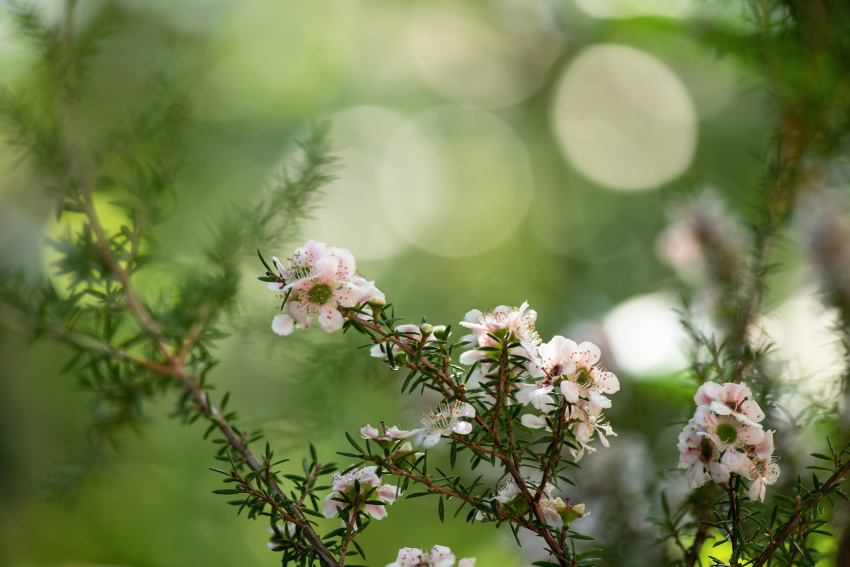
Triple negative breast cancer (TNBC) is a highly aggressive, hard to treat cancer – but an AUT study has shown a local plant may be able to help fight it.
The research, led by PhD candidate Harman Dhaliwal, was published in the journal Antioxidants and shows kānuka leaf extract contains high levels of polyphenols which have direct anticancer activity.
- October is Breast Cancer Awareness Month in Aotearoa New Zealand
- Kānuka oil is used topically on the skin to help irritation and joint pain
- Analysis shows kānuka leaf extract contains high levels of bioactive polyphenols
Current treatment options for TNBC are limited, and patients often experience poor outcomes, meaning new treatments are needed, says Dhaliwal. That’s where her research comes in.
Dhaliwal, who co-authored the study alongside Professor Michelle Yoo and Associate Professor Yan Li, says initial results working with kānuka extracts are encouraging but it’s just the start of a long process.
TARGETING RECEPTORS
“Unlike other breast cancer subtypes, TNBC lacks established targets for treatment,” Dhaliwal says.
“Chemotherapy has traditionally been a cornerstone of TNBC management. However, recent advances in cancer immunotherapy have expanded treatment options, particularly using immune checkpoint inhibitors.
“These agents enhance the immune system's ability to recognise and eliminate cancer cells and have demonstrated clinical benefits in selected patients with TNBC,” Dhaliwal continues.
“My study focused on whether the kānuka extract, because of the potential presence of bioactive polyphenols, could act on these immune checkpoint inhibitors.”
These proteins leave our body’s immune system compromised, meaning it cannot against cancer cells.
“So I thought if I deregulate that protein using the phytochemicals present in kānuka extract, maybe our body can distinguish cancer cells as foreign particles and maybe it can start fighting against them,” Dhaliwal says.
“That was the first objective of my research.”
And the research paid off, with the levels of the protein reduced by around 30 percent which, Dhaliwal says, is “not bad to start with.”
Other work by Dhaliwal and her collaborators showed more benefits of using kānuka extract.
“We showed the extract makes cancer cells die much faster compared to control cells which aren’t given the kānuka extract.”
NEXT STEPS
However, just because kānuka extract has shown positive activity against cancer cells, it doesn’t mean any new treatment for TNBC is close.
“Cell lines do not directly show what is happening in our body,” Dhaliwal says.
“To take it further, we need to see if it is working on other physiologically relevant systems. We can see it is toxic in breast cancer cell lines, but if we are going to commercialise something like that, we would need to see how our normal cells react to it too.
“There is a vast direction and a long way to go. But this is a foundation showing that a traditional Māori flora is active against cancer cells and it needs to be studied.”
Indeed, kānuka isn’t the first time something from these shores has been used in the battle against cancer.
“Eribulin is a fascinating example of natural product drug discovery with strong ties to Aotearoa New Zealand,” says Associate Professor Yan Li.
“It is an FDA-approved anticancer drug used to treat breast cancer, which was developed from a natural compound obtained from a New Zealand sea sponge.”
Useful links
- Kānuka (Kunzea ericoides)
- Triple Negative Breast Cancer
- Extraction, Phytochemical Analysis, and Bioactivity Evaluation of Polyphenols from Kunzea ericoides (Kanuka) Plant
- Professor Michelle Yoo’s academic profile
- Associate Professor Yan Li’s academic profile
AUT supports the role our academics play as critic and conscience of society, as set out by the Education and Training Act 2020.
Our approach to academic freedom and freedom of expression is set out in our Charter of Academic Freedom which was developed and endorsed by the AUT academic community.