From personal loss to chronic pain treatment
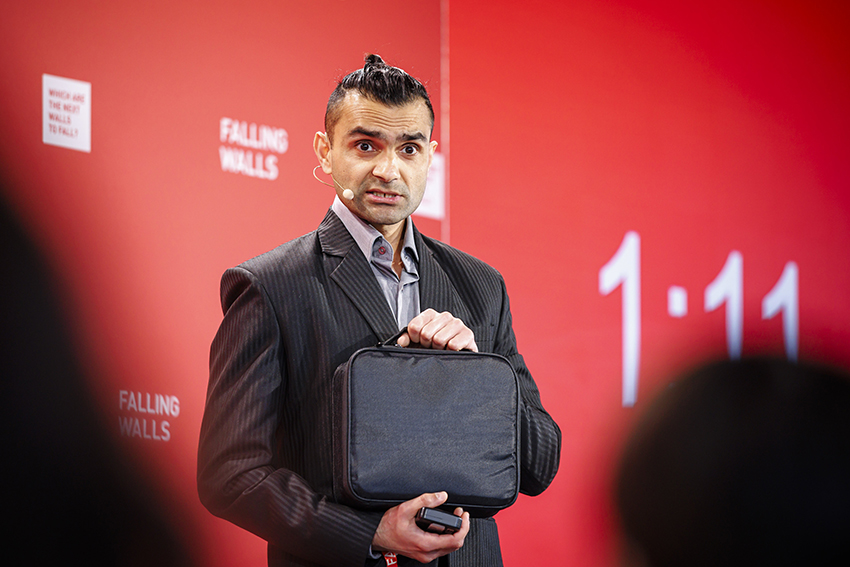
New research by Ankit Parikh from AUT’s School of Allied Health looks at how stimulation of the vagus nerve could mean a breakthrough in treating chronic pain.
Some of the most meaningful scientific journeys begin with deeply personal questions.
For me, those questions emerged through loss. My father lived with a traumatic brain injury (TBI) for more than a decade before passing away from septicaemia in 2018.
Then, in 2020, my mother passed away from complications of Covid-19 and septicaemia. Blood poisoning and terrible pain was again a cause of deep personal loss.
Shortly before her death, I learned about an experimental treatment called transcutaneous auricular vagus nerve stimulation (taVNS), which was being tested in critically ill patients in the United States.
So, although it was too late to help my mother, the potential of taVNS as a supplemental treatment for septicaemia and various other conditions - like chronic pain - stayed with me and making it accessible became the focus of my PhD.
Chronic pain - that is pain that persists beyond the usual recovery time - affects at least one in five adults in the Western world. Think long-term back or neck pain, migraines, arthritis and fibromyalgia as examples. And this number is likely higher in lower-income countries.
Many people report suffering from these conditions for years or decades and because chronic pain impacts a person's health, mood and overall quality of life, it ends up costing billions in healthcare and lost productivity.
Many of the current treatments we have, such as pain medications, are only partially effective or have side effects and risks that limit their tolerability and long-term safety.
While non-pharmacological or combined treatment approaches are frequently effective, access to care is limited by a lack of funding and available services. Alternative, home-based options to tackle chronic pain are needed.
This is where my research comes in. Pain typically becomes chronic due to factors like overactive pain processing in the brain, immune system dysregulation, and the body's overactive stress response.
The vagus nerve acts like a communication highway between the brain and many of the body's major organs and research suggests taVNS, which stimulates a branch of the vagus nerve located on the surface of the ear by delivering short electrical pulses, can help regulate pain, inflammation, and the body's stress response.
Additionally, stimulation timed to a person's exhalation was shown to be more effective in enhancing the therapeutic effects of taVNS in preliminary experiments. However, research examining these effects of taVNS and respiration had been limited to laboratories, due to the size of the equipment.
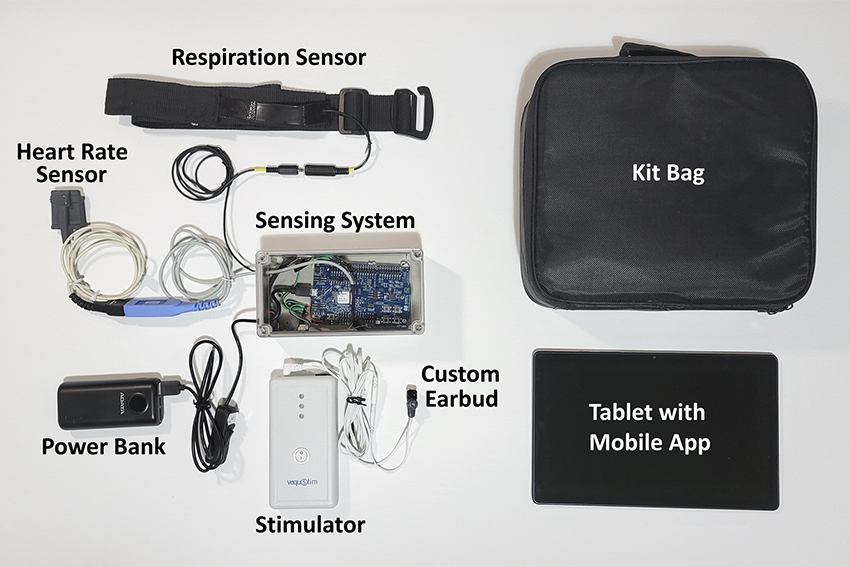
So, I set out to build a portable system that could deliver auricular vagus nerve stimulation during exhalation, allowing people to use the technology at home with wearable sensors, a stimulator, a custom stimulation earbud, and a mobile application that controls the entire system wirelessly.
During my PhD, I conducted two clinical studies. To build the sensing technology, I first conducted a study with 30 healthy volunteers to identify the most accurate sensors for monitoring breathing and heart activity. I then used those findings to develop the prototype.
In a second study, 12 people with rheumatoid arthritis used the prototype system at home daily for 20 minutes for two weeks. They also visited the hospital three times, during which we collected blood samples and asked questions about their pain and mental health.
The results were encouraging. Participants used the device consistently and reported that it was easy to use, and experienced no serious side effects. Many also reported reduced pain and improved mental health, with tumour necrosis factor-alpha - a blood-based marker of inflammation – also decreasing.
The research demonstrated that home-based, breathing-synchronised non-invasive vagus nerve stimulation is both safe and feasible. The prototype system is ready for the next stage: long-term and home-based clinical trials in people with rheumatoid arthritis and other chronic pain conditions.
It has the potential to become a drug-free, non-surgical option not only for pain management but also for improvements in mental health and well-being.
What began as a personal search for better treatment options has become a step toward making innovative health technology more accessible to the people who may need it most.
This article was written by Wilailak Maiwong about their research A Portable, Non-Pharmacological Intervention for Chronic Pain Management. It was originally published in the Sunday Star-Times Brainwaves feature. Read the original on The Post.
Useful links
AUT supports the role our academics play as critic and conscience of society, as set out by the Education and Training Act 2020.
Our approach to academic freedom and freedom of expression is set out in our Charter of Academic Freedom which was developed and endorsed by the AUT academic community.