Dramatic impact of Hunga volcano
An international research team, led by marine geoscientist Dr Marta Ribó from the Auckland University of Technology (AUT), has published a paper in Nature Geoscience which demonstrates the impact of the rapid submarine caldera collapse, and could help improve monitoring and early-warning systems for volcanic-tsunamis.
The eruption in the Pacific Ocean triggered deadly volcanic-tsunamis, global atmospheric pressure waves and delivered huge volumes of volcanic material into the ocean creating fast and destructive underwater flows which caused extensive damage to the subsea communication cables.
The team’s findings revealed the Hunga caldera has deepened from 150m to 850m, and that the total displaced volume of volcanic material was 8.9 cubic kilometres (equivalent to the volume of 1,500 Great Pyramids or 89,000 modern aircraft carriers).
Most of this material was displaced due to the collapse of the caldera, with the rest being surface erosion caused by eruption-fed currents. Despite the massive displacement, the material comprised less than 30% of the magma reservoir.
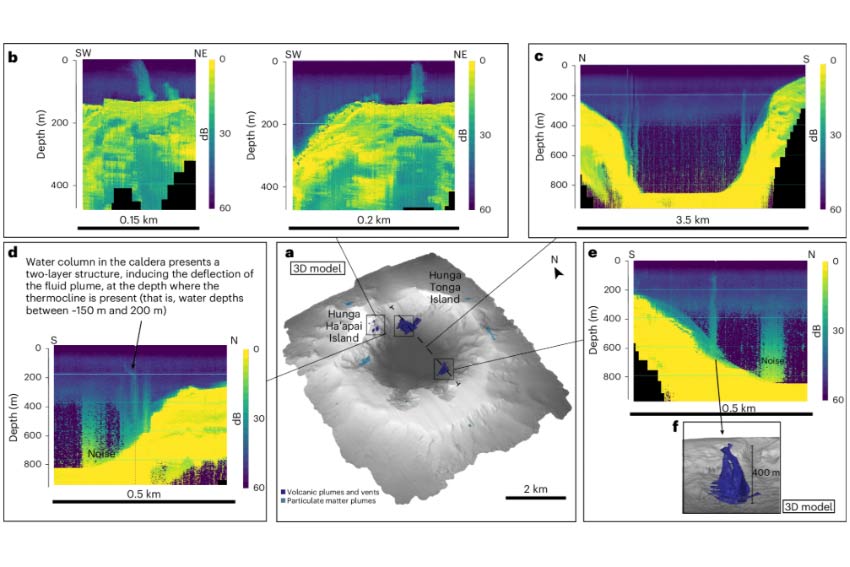
Using high-resolution bathymetric surveys and water column observations, the research team quantified the geomorphologic changes and calculated the total volume of material displaced during the eruption.
Dr Ribó says: "There are at least 74 submarine volcanoes along the Tonga–Kermadec Arc, with 20 caldera complexes. Yet, despite the hazards they pose, they are not well-understood as they remain unexplored. “
These types of submerged and volcanic-island calderas are associated with some of the largest and deadliest eruptions on Earth, including the 1883 eruption of Krakatau, Indonesia, which killed more than 30,000 people and caused widespread devastation due to resultant pyroclastic density currents and tsunamis.
Due to the steepness of the caldera and the speed of the caldera collapse, the 15 January 2022 Hunga volcano eruption produced an even larger tsunami than Krakatau, with waves about 40 m high at distances up to 100 km away from the source. Despite local devastation, fortunately few lives were lost.
Dr Ribó says: “Seafloor mapping before and after submarine volcanoes eruptions is very rare. Despite their recognised threat, most submarine caldera volcanoes remain unmapped. The bathymetric time-series of Hunga, before and after the 2022 eruption allowed us to better understand processes governing submarine caldera formation, caldera collapse dynamics and associated hazards such as tsunamis or dense underwater flows.”
The 2022 eruption event exposed a critical gap in global preparedness for submarine volcanic hazards.
"Our findings underscore the urgent need for high-resolution repeat seafloor mapping to capture the dynamics of submarine caldera formation and collapse. These time-series datasets are essential for improving submarine volcano hazard monitoring, strengthening tsunami early-warning systems and protecting critical seafloor infrastructure, particularly in poorly surveyed regions such as the southwest Pacific."
The Nature paper was led by AUT's Dr Ribó in association with 22 collaborators across different research institutions, with joint efforts from Tonga (Tonga Geological Services, Ministry of Lands and Natural Resources, Government of Tonga), New Zealand (University of Auckland, Earth Sciences New Zealand, University of Otago), Republic of Korea (Korea Polar Research Institute), Australia (Echoview), the US (NASA), and the UK (National Oceanography Centre).
Useful links
AUT supports the role our academics play as critic and conscience of society, as set out by the Education and Training Act 2020.
Our approach to academic freedom and freedom of expression is set out in our Charter of Academic Freedom which was developed and endorsed by the AUT academic community.