Auckland kids missing outdoor play
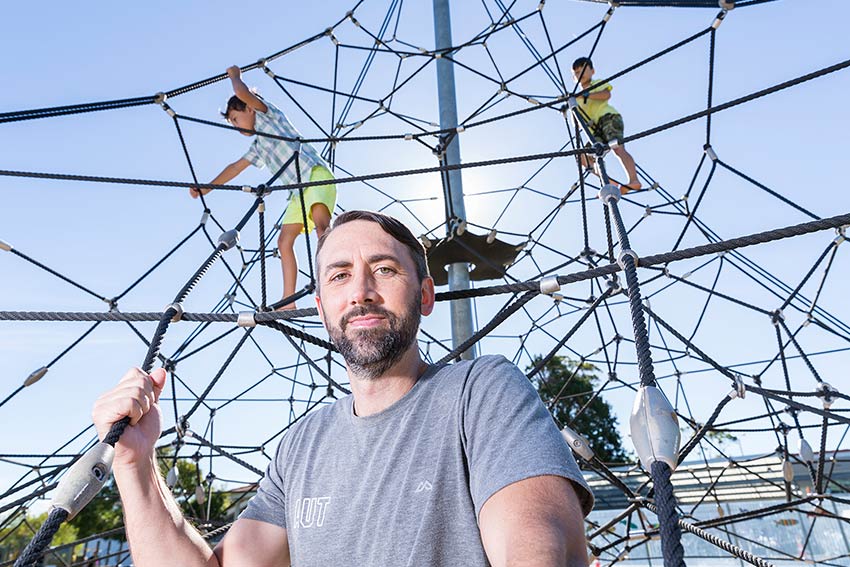
Only one in five children in Tāmaki Makaurau regularly climb trees, sharply down from almost one in three a decade ago, according to new data released for Play Week Aotearoa.
AUT Professor of Population Health Scott Duncan is part of the Healthy Auckland Together (HAT) Play Working Group, which is releasing a new position statement on outdoor play to coincide with Play Week Aotearoa (19–25 October).
The statement draws on AUT-led State of Play research showing substantial changes in children’s outdoor play and the way parents manage their children’s physical activity.
AUT's State of Play survey reveals:
- Only 20% of Auckland children regularly climbed trees (down from 31% in 2015).
- 37% regularly used bikes or scooters (down from 48% in 2015).
- 43% of Auckland parents feel judged if they let their child play freely.
- 46% feel as if they are always driving their child to an organised sport or activity (up from 26% in 2015).
- 30% feel that the number of organised sports or activities their child participates in is a source of stress for the family (up from 9% in 2015).
- 41% think that finding ways to get children active is expensive these days (up from 23% in 2015).
Professor Duncan says the findings suggest keeping children active is increasingly becoming something parents have to organise, supervise, pay for and transport children to.
“We’ve made something that can be a natural part of everyday childhood much more complicated.”
The survey also found Auckland children were less likely than children elsewhere in New Zealand to regularly ride bikes or scooters (37% vs 48%), play in nature (49% vs 61%), or play in the rain (22% vs 30%).
“Outdoor play needs to be treated as an important part of urban health and wellbeing, rather than simply recreation,” says Professor Duncan. “It’s an essential feature that supports healthier people, stronger communities, and more liveable and resilient cities. It’s not an optional amenity.
"Too often, we’re designing play out of our neighbourhoods. Traffic, concerns about safety, more time spent indoors and on screens, reduced independent mobility, and unequal access to quality green space all shape whether children have opportunities to play outside."
How do safety concerns impact outdoor play?
The State of Play findings also highlight how constrained children’s independent mobility has become. Most Auckland parents believe children should be at least 12–13 years old before roaming their neighbourhood with friends, and 14–15 before roaming alone. Sixty-one per cent also believe good supervision means knowing what their child is doing at all times, up from 49% in 2015.
The HAT position statement highlights that opportunities for outdoor play are not distributed equally. Māori and Pacific communities experience broader structural inequities, while lower-income communities, Asian peoples, other minoritised communities, and whānau and tamariki living with disability can face additional barriers to safe, welcoming and inclusive outdoor play.
“Where a child lives, their circumstances, culture or ability shouldn’t determine whether they have opportunities to play outside,” says Professor Duncan.
How can more children get more play?
HAT says reversing these trends will require coordinated action across transport, planning, housing, education, public space design and environmental policy.
“We can’t keep putting the responsibility on parents or simply telling children they need to get outside more. We need to create neighbourhoods where outdoor play is an easy, normal part of everyday life.
“The environments we create have a huge influence on whether that is actually possible.
“We want a Tāmaki Makaurau where outdoor play is an ordinary part of everyday life, supported by safe streets, playable neighbourhoods, quality green spaces and equitable access to nature and community spaces,” says Professor Duncan.
The HAT position statement calls for action to:
- design neighbourhoods and public spaces for outdoor play, with inclusive, high-quality play and green spaces close to where people live;
- create safer and more playable streets, including traffic calming, low-traffic neighbourhoods and safe walking and cycling infrastructure;
- support outdoor play through schools and communities, including daily opportunities for outdoor play and learning and greater community use of school grounds;
- embed Te Tiriti o Waitangi and Māori-led approaches, including mana whenua leadership, mātauranga Māori, tākaro Māori and restoring relationships with te taiao;
- measure and monitor outdoor play and inequities in access to inform planning and investment.
Healthy Auckland Together is a coalition of more than 20 organisations across health, local government, mana whenua, academia, NGOs and community organisations, working collaboratively to create environments that support healthier lives in Tāmaki Makaurau. AUT is one of the partner organisations.
Useful links
- Professor Scott Duncan academic profile
- Healthy Auckland Together | Transforming the health of our city
- Study Sport and Recreation at AUT
AUT supports the role our academics play as critic and conscience of society, as set out by the Education and Training Act 2020.
Our approach to academic freedom and freedom of expression is set out in our Charter of Academic Freedom which was developed and endorsed by the AUT academic community.