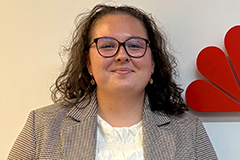
Rebecca Pratt

Founder, Salty Slate Productions & Science Communicator
Master of Communication Studies with Honours (First Class)
Bachelor of Communication Studies in Television and Screen Production
The ocean is a never-ending film set, says Rebecca Pratt who studied screen production and has now built her own film production company.
“I’m most proud of founding my own production company and building a body of work that helps people see and value the ocean more clearly. Since graduating, I’ve been able to translate complex ocean science into enjoyable, educational work for the public. I love taking something technical or hard to access, and turning it into storytelling that people actually want to watch, read or share, because that’s how awareness grows into care and, hopefully, better decisions for our ocean.
“What I love most about the work I do is that it’s constantly changing, full of surprises and always offering new stories to uncover, from tiny details on a reef to big, migratory species moving through our waters. Also, SCUBA diving is part of my job! It’s a dream.”
Her work as a film producer can be seen at both a local and international level, and she is proud of what she has achieved so far.
“On the film side, Reef Revolution (2019) and Manta Watch (2023) are big milestones because they took local marine stories and made them accessible, helping audiences connect with species and places that are often out of sight. SEAWEED: A Love Story (2025) brings attention to the quiet, foundational ecosystems that hold our coastlines together. And Mining the Shallows (coming in 2026) is a major achievement because it tackles a complex, high-stakes issue and aims to support informed public conversation about our ocean’s future. It will be my first feature film, and the process so far has been full of immense learning. I’m also incredibly proud of publishing my first children’s book, Shelf Life. Reaching young readers feels powerful because it’s about growing ocean curiosity early, in a way that’s hopeful and engaging.”
Encouraging outside-of-the-box thinking
She still has fond memories of her time at university and says she appreciated the outside-of-the-box thinking AUT encouraged.
“I felt supported to take creative risks, ask bigger questions and follow ideas that didn’t fit neatly into a standard template. That matters when working in ocean and coastal spaces, where the issues are complex, layered and deeply interconnected. Being able to think across science, community and cultural knowledge, media and policy is essential, and AUT supported that kind of multi-layered thinking.
“One of the biggest highlights of my time at AUT was learning from lecturers and supervisors who brought real-world experience into the classroom. Their teaching wasn’t abstract or purely theoretical; it was grounded in how communication actually functions in practice, which made the learning immediately useful and easier to apply to my own work in ocean storytelling.”
Her studies also directly connect to the work she is doing today.
“My master’s degree thesis culminated in a practice-based documentary, Manta Watch: Discovering Aotearoa’s Gentle Giants. The film gained international festival recognition, including selection at the Maui Film Festival, and subsequently toured nationwide across Aotearoa New Zealand, helping bring oceanic manta rays into the public eye and supporting conservation outreach. My thesis has also been accepted for presentation at Sharks International 2026 in Sri Lanka; the world’s largest scientific conference focused on sharks, ray and chimaeras. It takes place every four years, so it’s a real honour to be presenting there.”
Supported to thrive
There were a few AUT staff whose support she particularly appreciated, says Rebecca, who graduated with her master’s degree at the end of 2024.
“The screen production team within the Department of Screen, Audio and Journalism supported me throughout both my undergraduate and postgraduate studies, and really encouraged me to use our Pacific Ocean as a focus for my work. They helped me see the ocean as a serious and powerful research topic, not just a backdrop for stories. My master’s degree supervisors – Associate Professor Arezou Zalipour and Associate Professor Christina Milligan – were a huge support. They helped me turn a really important conservation story into clear research questions, backing me to explore topics I genuinely care about. I also loved being able to screen and present my research at the AUT Centre for Screen Practice Research.”
She has some great advice for other students.
“Put real effort into connections. Listen early and often to feedback, to the people closest to the issue you’re exploring and to the communities your work might affect. Back your ideas, even if they feel a bit ‘out there’ at first, and use your time at AUT to experiment, ask big questions and build the skills to bring your vision to life. The projects you start as a student can become the foundation for your career if you stay curious and keep showing up.”