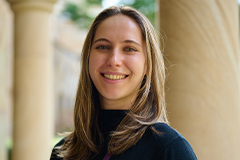
Neuty Abedin
Junior Materials Scientist, Dennisson Technologies
Bachelor of Science in Chemistry
The more she learned about chemistry, the more she realised how deeply woven into everyday life it is, says Neuty Abedin who studied a Bachelor of Science in Chemistry.
“Browning meat while cooking is driven by chemical reactions like the Maillard reaction. Cleaning products remove grease because of specific molecular interactions between surfactants and oils. The batteries in our phones and laptops rely on redox reactions to store and release energy. Sunscreen protects our skin because carefully designed chemical compounds absorb or reflect harmful UV radiation. Chemistry also sits at the centre of many of the most pressing global challenges we face today – developing sustainable materials, improving waste management processes, designing cleaner industrial systems and advancing renewable energy technologies. I was drawn to the idea that chemistry isn’t only about understanding the world but also about improving it.”
Choosing where to study chemistry was an easy decision for her.
“During my university visits, I noticed that AUT’s class sizes and staff-to-student ratio were far more balanced compared to other universities. This created a more personalised learning environment, where I felt I would receive greater academic support and engagement. The smaller classes allowed me to build strong relationships with my peers and spend more time discussing concepts in depth with my lecturers. It also meant there were more opportunities to participate, ask questions and be actively involved in my learning.
“In addition, the chemistry courses at AUT were more skill-focused rather than purely theoretical. This practical focus helped me build confidence in applying theoretical knowledge and made the transition to the workplace much smoother. I especially enjoyed working alongside my peers in the lab, where we collaborated on experiments, shared plenty of laughs and bonded over the occasional mishap. I also valued the opportunities provided by AUT clubs, like going on walks with the Off Grid Club and meeting inspirational guest speakers through AUT STEM Women.”
Supported to thrive
Neuty says there were several AUT staff members who played a significant role in supporting her throughout her degree.
“Associate Professor Marcus Jones had a particularly strong impact. I found his course more challenging than others, but Marcus had an excellent ability to explain complex concepts. He was always willing to answer questions after lectures and offer guidance, and his tutorials were thorough and well structured. At the end of my second year, I was awarded a summer research scholarship on his microfluidics project, working closely with his PhD student and a lecturer from the University of Auckland. The experience inspired me to undertake a research project in my third year and pursue a research role after completing my degree.
“Sunnie Vo was also incredibly supportive. She organised my third-year workplace experience placement at Watercare and successfully ran AUT’s first chemistry placement project. When I encountered challenges with my research project and needed to change direction, she provided valuable guidance and helped me secure a new supervisor. Even after I graduated, she continued to support me by sharing job opportunities and helping to arrange an interview. I also received meaningful support from Dana Toogood, one of the health coaches. She was consistently kind, supportive and offered practical advice to help me manage stress during my studies.”
Neuty has some great advice for other students who are only at the start of their own university journey.
“Choose a field you’re genuinely passionate about, while also considering the types of jobs it leads to and whether they align with your long-term goals and values. What you study and what a role actually involves can differ significantly in reality, so it’s important to look at both. Don’t limit yourself to your major, as most careers require a diverse skillset. Taking additional courses that are both interesting and relevant to your field can be highly beneficial; for example, even in science, subjects like business or software development can contribute greatly to both career prospects and personal growth.
“Finally, stay proactive in exploring the many services and opportunities AUT offers. Scholarships, seminars, clubs and support services can easily go unnoticed, but making full use of them and building meaningful connections during your time at university can have a lasting impact on your career.”
An interesting research role
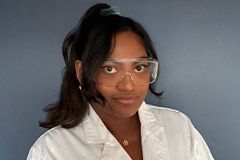
Since graduating from AUT, Neuty loves working as a junior materials scientist at Dennisson Technologies.
“I started at Dennisson Technologies as a materials intern and began my full-time role after the internship. My role primarily involves synthesising and characterising liquid crystal elastomers that extend in shape when exposed to UV light and can lift up to 750 times their own weight. The role requires staying up to date with emerging research, as well as designing and conducting experiments to improve our baseline product and deepen our understanding of its functionality.
“What I enjoy most is reading exciting new research papers, and then having the opportunity to conduct the work myself and see the results firsthand. Because this is a fairly new area of research, there’s a great deal of trial and error, which keeps the work engaging and ensures that I’m constantly learning something new. I also value having independence to propose and carry out my own ideas, which is something I’m very grateful for.”
Another aspect of her role she loves is being encouraged to learn beyond chemistry.
“I work closely with the engineering and software teams, and through this collaboration I’ve developed new software and coding skills and gained experience in 3D printing. The role itself varies from day to day, so there are no slow days. My work ranges from hands-on lab experiments and measurements, which keep me on my feet and working with instruments, to documentation and computer-based tasks. I find this balance between practical and desk-based work both fulfilling and well-suited to me.”