José Antonio Martínez-Rodríguez
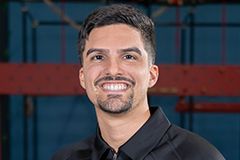
Doctor of Philosophy candidate
He wanted to build deep expertise at the intersection of sport science, biomechanics and baseball performance, while producing research that could have direct value in applied environments, says José Antonio Martínez-Rodríguez who is AUT’s first international student from Puerto Rico in recent history.
“Rather than studying performance in a general sense, I wanted to focus on a problem that matters in competition, can influence decision-making and still remains underdeveloped in literature. Doctoral study gave me the platform to develop that work at a high level, contribute original knowledge and position myself to lead in this area professionally.”
His PhD research – supervised by Professor John Cronin – focuses on advancing base running performance in baseball through data-driven, sport-specific assessment and training, with particular emphasis on curvilinear sprinting in game contexts. He believes this research can help coaches, sport scientists and performance staff assess base running more accurately, select useful technologies with greater confidence, interpret movement metrics more meaningfully and design training that is specific to the real demands of baseball.
“I chose this area because base running is a decisive component of baseball performance, yet it has often been oversimplified through linear sprint measures that don’t fully capture what players actually do when accelerating and rounding bases when advancing between bases. What makes this programme of research distinctive is that it has progressed as a connected body of work rather than as isolated projects. It began with addressing the literature gap around baseball-specific base-running movement training and assessment, based on work I developed during my master's degree, the Curvilinear Ability Test (CAT), a field-based assessment designed to quantify base running curvilinear sprinting and change-of-direction performance. At AUT, I expanded that foundation into a broader doctoral research agenda.
“The next stage of my PhD examined the technologies needed to study base running properly in field environments. I investigated the between-session reliability of GPS and IMU foot pod systems for quantifying both linear and curvilinear base running performance. From there, I progressed into the exploration of baseball-specific performance metrics, using GPS and IMU foot pods to examine speed profiles, stride characteristics, ground contact patterns and the mechanical demands of running multiple bases. Recently, my work extended into assessment and intervention by incorporating wearable resistance training to determine whether targeted external loading can improve base running efficiency, curvilinear ability, jumping and lower-body strength in baseball players.”
An enjoyable PhD journey
He chose AUT because of its strong reputation in applied sport science and the opportunity to undertake his PhD within the Sport Research Institute New Zealand (SPRINZ), says José who will complete his doctorate in May 2026 and plans to continue bridging base running science with applied baseball environments, ideally within an MLB organisation or elite baseball academy.
“AUT offered the kind of environment I was looking for: academically rigorous, technologically capable and strongly connected to real-world performance practice. It was important for me to study in a place where research isn’t only published, but also designed to inform coaching, athlete development and high-performance decision-making.”
It's a decision he certainly hasn’t regretted, and he thoroughly enjoyed his PhD journey with AUT.
“What I’ve enjoyed most about my studies at AUT is the opportunity to develop a line of inquiry from concept to application. I’ve been able to move from identifying a performance problem to examining the validity and usefulness of technology, to exploring movement metrics, and then into training interventions with practical relevance. That translation process has been especially rewarding.
“I’ve valued being part of SPRINZ and the wider AUT research environment, where there is a strong appreciation for work that is both scientifically rigorous and useful beyond academia. During my doctoral studies at AUT, I was invited to present at the NSCA Puerto Rico State Clinic in both 2023 and 2024, which gave me the opportunity to represent my work and contribute to professional development within the strength and conditioning community in Puerto Rico. More recently, I was invited to participate as a panellist in the Puerto Rico Sport Performance Summit discussion titled ‘El futuro del deporte Boricua’, which is a meaningful opportunity to contribute to a broader conversation about the future of sport performance in Puerto Rico. I was also honoured to be a two-time NSCA Foundation scholarship awardee. Together, these experiences have been important markers of professional recognition during my time at AUT.”
Advice for other students
José has some great advice for other students.
“My advice would be to choose a problem that genuinely matters to you and to approach postgraduate study as professional formation, not just degree completion. Work becomes much more meaningful when you can see how your research connects to real performance, health or community need. I’d also encourage students to stay intellectually curious, ask for guidance when they need it, and remain patient with the process. A postgraduate journey can be demanding, but it is also a powerful opportunity to build expertise, resilience and a clear professional identity.”
He wouldn’t hesitate to recommend AUT’s PhD in sport science to others.
“AUT provides a strong combination of academic quality, applied research opportunities and supportive supervision. For students who want their work to have both scholarly and practical value, it offers an environment where that is genuinely possible. The programme also supports independent thinking while still providing the structure, mentorship and research culture needed to develop as a professional.”