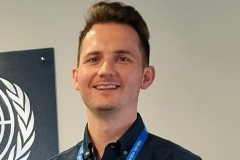
Harry Creevey
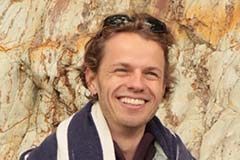
Operational Analyst, Statistics New Zealand (Stats NZ)
Graduate Diploma in Science student
Graduate Diploma in Science graduate Harry Creevy would be the first to admit that his journey towards studying science was far from straightforward.
“I started university studying genetics, but then changed my major after my first year and graduated with a Bachelor of Arts majoring economics, statistics, and film and media. After two and a half years working in local government and a gap year teaching English, maths and biology in a high school in Spain I realised that I really wanted to pursue my passion for the environment. Because most of the roles in this area require a degree in ecology or environmental science, I decided to complete the Graduate Diploma in Science.”
When Harry explored his study options to help him pivot his career, he would soon find himself at AUT.
“I chose AUT because they were really flexible and allowed me to launch straight into the more advanced science courses in the graduate diploma, unlike some other universities. I was confident in my ability to go straight into the advanced courses and liked the fact that AUT trusted me to judge my own ability. I didn’t want to have to spend more time and money completing introductory courses when I know the specific areas I’m interested in.
“One of the biggest challenges for me was the fact that I decided to study right before enrolments closed. I had to be accepted and get all my courses sorted out in about a week. The science administration team was great and completed this for me really quickly. In contrast, another university I had applied for only just got back to me at the end of the current semester.”
More personal and flexible
Harry says he enjoyed the smaller classes and being able to get to know his lecturers.
“I previously studied at two other New Zealand universities, doing some first-year health science courses at one and studying economics at the other, and there were always massive lecture theatres and not a lot of small group connection with the lecturers. At AUT the small classes make it easy to connect with people and it means you can actually get to know your lecturer. I didn’t just feel like a number at AUT, I felt like they really cared about my ideas and what I wanted to pursue. I also think it’s really cool that AUT has a project like the Living Labs project where we could test new approaches to conservation and gather evidence about the best approaches to restoration.”
He also appreciated the greater flexibility his timetable offers.
“I enjoyed the structure of the timetable at AUT the most out of any of the universities I’ve been to; Auckland, Otago, AUT and UC Berkeley. I liked that I usually had one or two longer classes a week rather than four hour-long classes every day. I think this system works well for a university where lots of people commute. I was living in Whangaparāoa for most of the semester, which would have been a three-hour round trip for an hour-long class. Having one longer lecture meant it was easier for me to make it to class, and I always performed better when I go to lectures in person. It also made it easier to work part-time while studying.”
Putting his skills to work
After completing his graduate diploma in 2025, Harry now works as an operational analyst at Statistics New Zealand (Stats NZ) on the new census project.
“I applied for quite a few ecology and environmental science jobs, and then this one came up. I thought the census would be a really interesting project to work on and thankfully I got the role. Though not directly related to ecology and environmental science, I use the analytical thinking and research skills I gained through studying science every day. I've also used ArcGIS, which I learned through the graduate diploma, to help solve some problems which would have been really tricky to solve without using this software.”
He has some great advice for other students who are only at the start of their own university journey.
“My advice is to study something that makes you excited to go to class. I also think it's important to keep an open mind when applying for jobs, especially when the job market is tough, and apply for jobs that interest you, even if you don't feel qualified – experience is good but in most jobs passion is more important.”