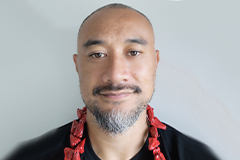
Gary McNicholl
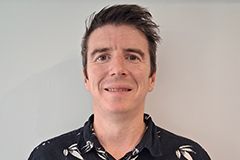
Allied Health Programme Consultant, Health New Zealand | Te Whatu Ora
Doctor of Health Science
Dr Gary McNicholl knew it was time to return to study when he found himself increasingly involved in leadership roles and workforce planning, data and change management; areas that weren’t covered in his original training as a physiotherapist, but were central to the challenges he was facing day to day.
“I had been working in district health board roles since I moved to New Zealand in 2013, and from around 2017 on I started moving into leadership and project roles. I was interested in allied health workforce planning, and capturing data about how allied health staff were spending their time. I wanted to explore what had been done in research internationally around allied health workforce planning, to then apply some structure and an evidence base to what I was trying to do.”
Because he wanted a doctorate that was integrated with his day-to-day practice, he soon found himself looking into AUT’s Doctor of Health Science.
“I wanted to be able to bring my knowledge and research into the real world. The Doctor of Health Science felt more practice-orientated and focused on leadership aspects that could blend into my day-to-day job, whereas a PhD always felt quite abstract. I appreciated the core courses that helped me build my research question and problem, and understand what methodologies and what research philosophies I could use to underpin my approach.
“The other benefit was that during those courses I met many different researchers and supervisors, which I thought was really helpful. The ability to network and hear from other people in the same boat who had similar problems or similar research problems was so helpful. I enjoyed hearing from recent graduates and researchers who talked about their research problem, and how they applied their research philosophy, whether it be their doctorate, their master’s or more recent publications.”
Opening doors
For Gary, the impact of completing the Doctor of Health Science on his career was immense.
“Professionally, my doctorate has opened up a lot of doors. I was a team leader within a district health board with a small portfolio in informatics and health analytics, and over the course of the doctorate I moved more into the leadership space, including the national workforce planning and development role I’m in now. I love that my role is directly related to my thesis, which is really lucky. I wrote about the changes I'd like to see happening in my thesis, and now I'm trying to live them in my day-to-day job, which is really exciting. The programme has shaped me to go for a job like this and I wouldn't have had the confidence or the knowledge without my doctoral journey.
“I definitely have a different perspective on my topic than I had before, with a lot more in-depth knowledge and understanding. Now I recognise how you can use the data to inform better practice and better models of care. I've applied my findings from my research to several national policy documents, including a training module we’re working on at the moment to support more consistent data quality. My studies have helped me grow my change management, project management, analysis and communication skills, and I’m more aware of the current literature and different aspects of current research we should consider when we're doing a piece of work.”
The doctorate has also opened doors beyond his immediate role.
“I've had articles based on my research published in the Australian Health Review and the New Zealand Journal of Physiotherapy. I've presented at a couple of conferences, and sharing my research with different people has been a privilege. I've built international connections across the Tasman and in the UK and Ireland.”
Advice for other students
Gary, who graduated with his Doctor of Health Science in 2024, has some great advice for other students interested in this programme.
“I’d say try to thrive in the messiness of doctoral research. Sometimes you almost have to sit on that uncertainty when there's so much data and so many ideas. It takes months of thinking, writing and whiteboarding. Have patience and trust the process.”
He speaks from personal experience.
“I definitely thought, ‘We'll do the introduction. We'll do the literature review. We'll do the data results and then we'll all be tickety boo.’ But it's not a straight line because you often go, ‘Hold on. What about this?’. The supervisors are amazing help with this messiness of the doctoral journey, but you need to sit in that uncomfortable space because that’s where all the recommendations are and where the magic happens.”
More about Gary and his work
- Doctoral thesis: The Value of Allied Health Activity in a District Health Board Setting in New Zealand
- Clinical care ratios: differences in allied health roles in New Zealand (Australian Health Review)
- Allied health activity: The challenges of legitimising and prioritising meaningful work (New Zealand Journal of Physiotherapy)