First PhD concludes 25-year celebrations
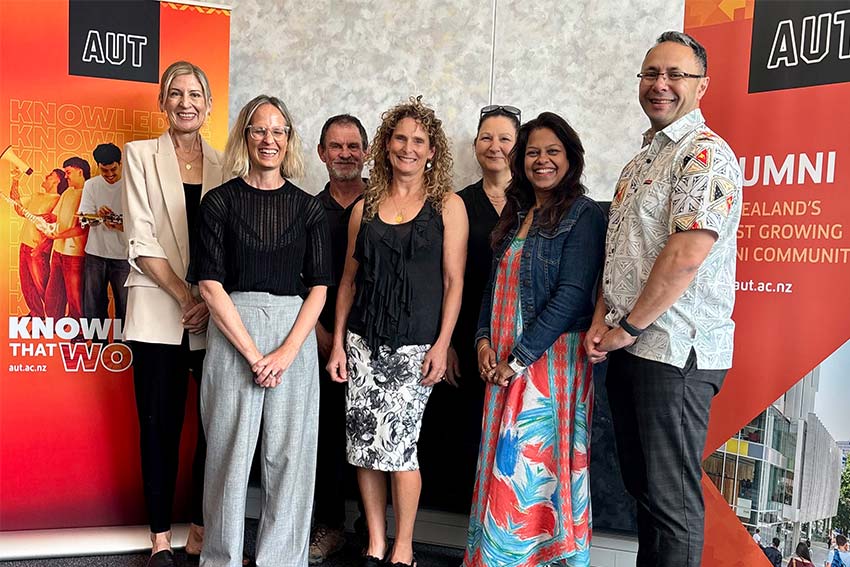
AUT’s first Doctoral graduate, Dr Debbie Blake, visited AUT as an apt end to a year of celebrating 25 years as Aotearoa’s only university of technology.
Dr Blake was joined by colleague and AUT alumna Eleanor Williams and her PhD supervisor Emeritus Professor Steve Henry at a special morning tea.
Debbie and Eleanor both work at Repromed a leading fertility clinic. Debbie provided some insight into her time at AUT:
You were the first person at AUT to achieve a Doctorate - can you tell us about your area of study?
Looking back, my research was pretty ambitious in its scope and ultimate goal: to design novel molecules that would enhance embryo adhesion to endometrial cells, which is a crucial step in implantation and pregnancy. To achieve this, I first extracted complex lipids from brain tissue, which served as the foundation for the development of innovative constructs, called FSL molecules (Functional-Spacer-Lipid). The molecular design, allowed us to attach a variety of functional head groups to these molecules, enabling them to anchor spontaneously into cell membranes, then facilitate novel interactions with other cells. Given my background in human-assisted reproductive technologies and a deep commitment to improving the low implantation rates seen in IVF, I set out to enhance the effectiveness of this process. Whilst we didn’t completely achieve this lofty goal, we did successfully demonstrate the core principles that lead into several patents.
What made you decide to go with AUT – some would say it was a brave choice given our ‘newness’ at the time?
AUT was actually the fourth PhD opportunity I explored. At the time, I was living and working in Sweden, so I had considered several universities in Europe and the US that were offering embryology-related projects. However, what ultimately drew me back to New Zealand was Prof. Steve Henry’s plan to establish a new research facility at the Auckland Institute of Technology (as it was known then). His enthusiasm for translating his work on blood groups into applications in embryology was impressive, and I knew I had the skills and passion to contribute to such an initiative. The appeal of having the autonomy to build a new embryology research facility from scratch was especially exciting to me.
During my first visit to AUT, I felt an immediate connection. It was a ‘grassroots’ university producing graduates with practical ‘real-world’ skills, which resonated with my family’s manufacturing background and values. My father was a pioneering plastic engineer back in the 1950s. Among his many innovations was the first baby incubators at National Women’s Hospital, that coincidentally was later adapted into New Zealand’s first IVF embryo buggy and the one I used in my early embryology career!
I remember feeling very fortunate to be offered the inaugural AUT PhD scholarship. I also remember feeling slightly intimidated sitting across from the legendary Prof Roy Geddes, Head of Science at AUT, who in his booming Scottish voice told me, 'If you're going to be AUT’s first PhD graduate, your project better be a bloody good one!
Do you remember the actual graduation? Where was it, who was there (friends and family) and how did it feel?
I vividly remember my graduation day at the Bruce Mason Centre because I had just become a new mum and had to balance baby duties with delivering the Valedictory Speech – and I was late!
Were there people from faculty or elsewhere who supported you?
My mum, husband, and supervisor were my biggest supporters throughout the PhD journey, so it was super special to have them there. Several of my own PhD students were also in the audience, two of whom later became invaluable colleagues of mine in my current role.
How did your academic achievement help with your career
The key thing was how it widened my circle of influence, in embryology practice, and empowering students or colleagues to feel confident in pursuing their own goals. My greatest career highlights have always been the births of healthy IVF babies, and knowing I played a role in their creation, is truly humbling.
What would you say to current or potential PhD students – any words of advice?
Simply to choose a supervisor you are inspired by, and a topic you are passionate about, because 3+ years is a long time to remain motivated (and broke!) on top of all the other years of study it took you to get there.