Boost for AUT immunology research
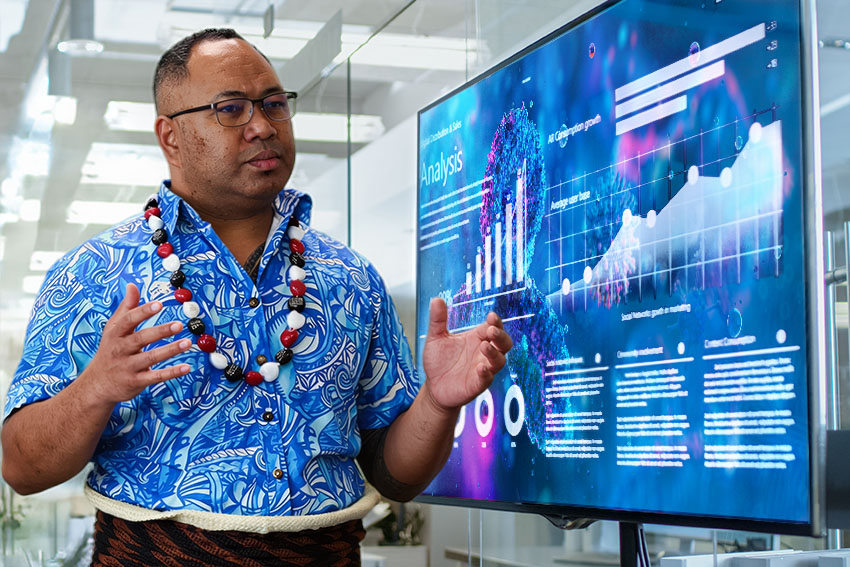
Improved health outcomes for Māori and Pacific people will result from a major boost to AUT’s immunology research expertise.
The launch of the AUT Biomedical Science Clinic brings together researchers in biomedicine and medical diagnostics in collaboration with the MAISci Māori and Indigenous Science Rōpū and Te Ranga Tukutuku AUT Māori Research Network.
A key feature of the clinic located in the AUT Science building is the introduction of the Invitrogen Attune Xenith Flow Cytometer. This equipment was secured through AUT capex investment with support from Thermo Fisher Scientific.
Lead academic for the project, senior lecturer in Biomedicine and Molecular Diagnostics Dr Chris Puli’uvea, said AUT is the first to have this equipment in the Asia, Pacific, Japan region. “Not even Australia has one of these. We’ve nicknamed it the ManaFlow.”
The benefits of the flow cytometer include faster and more accurate results. “It’s very user-friendly and virtually foolproof. Other instruments take 20 or 30 minutes to work up a sample, this does it in four minutes.

“It enables detailed analysis of the immune system from blood and a wide range of biological samples, significantly expanding AUT’s capability in immunology and precision medicine research.”
Dr Puli’uvea’s research centres on how genetic variation influences immune system function in Māori and Pacific peoples. These groups are often underrepresented in global research, limiting how well current medical advances reflect their needs.
His work addresses this gap by examining how population-specific genetic variants shape immune responses and impact health. His research spans conditions such as infectious diseases, cancer, and autoimmune disorders, with the aim of developing more precise and effective solutions that are better aligned with Māori and Pacific communities.
Associate Professor John Perrott, Associate Head of School Māori Advancement and MAISci, said: “This kaupapa reflects a step forward in building research capability, strengthening partnerships, and growing expertise within the university. It signals a long-term vision to advance knowledge and support improved health outcomes for Māori and Pacific peoples.
“Through this collaboration, the clinic provides a space to strengthen Māori and Indigenous research capability while supporting work that is grounded in community and real-world impact.”
Its establishment builds on strong foundations established through the MAISci Māori and Indigenous Science Rōpū. The MAISci Rūma Noho provides a dedicated wāhi manaaki for Māori and Pacific tauira supporting their success in science through teaching, learning, and community.
The Eke Tangaroa programme has also played a key role. As a pathway for early career academics, it supports the development of Māori and Pacific researchers and has helped grow the expertise behind initiatives such as this clinic, including the appointment of Dr Puli’uvea.

The launch also brought together Faculty of Health and Environmental Sciences leaders, AUT Research leaders including Professor Mark Orams Deputy Vice Chancellor Research and key partners and supporters, including Professor Tania Ka’ai, Dr Toiroa Williams and Te Haua Taua from Te Ranga Tukutuku AUT Māori Research Network, international representatives from Thermo Fisher Scientific who travelled from Australia; healthcare leaders Barbara Stevens, Chief Executive of Auckland PHO, and Ashley Hulme, Chief Operating Officer; and David Hemopo, Regional Lead – South Auckland for the Pūhoro STEMM Academy.