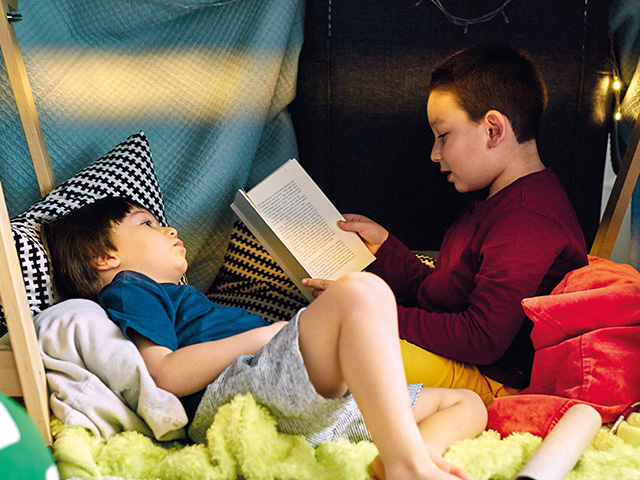

Our research - LitPlus
LitPlus research develops a sociomaterial, community-focused approach to children’s literacy. It brings together community-based research with evidence-based and interpretive methods to rethink engagement and communities of readers beyond individual traits or classroom-bound explanations.
Our work responds to three key gaps
- The lack of attention to material environments and social–emotional relations in mainstream reading psychology
- Unequal access to reading for pleasure across communities, including Indigenous and culturally diverse groups
- The mismatch between school practices and the everyday reading pathways of children, especially the undervaluing of out-of-school, multimodal, culturally diverse and digital engagements
We treat reading as relational, mobile and shaped by environments. It emerges through interactions among people, objects, spaces and cultural histories, where pleasure, belonging, and shared experience matter.
Literacy design, from this perspective, involves reshaping environments and relationships so reading can thrive in immersive, voluntary, and socially connected ways across homes, schools, and communities.
Current research projects
Investigating Affective Engagements with Reading and Writing in Schools and Early Learning Services
Summary
The research is embedded within a newly established partnership between AUT School of Education, schools, and early learning services in the Auckland area. The intervention consists of developing case studies of approximately 3 children or young people each across 11 sites (33 children total) during the first half of 2024. Each case study will pursue 2 core research questions common across the schools and ELS. To provide site specific information, one to two additional practice-related questions will be developed in partnership with each site.
Researchers: Ruth Boyask, John Milne, Ross Bernay, Lisa Maurice-Takerei, Parisa Tadi, Rebecca Hopkins, Jayne Jackson, Necia Stanford Billinghurst
Core questions
- How do children or young people engage in reading in and outside of educational settings?
- What affects and is affected by these engagements?
In 2024, the LitPlus research team worked with two postgraduate teacher education students to evaluate the impacts of author talks provided by Storylines Story Tours on students’ literacy development through interviews and questionnaires completed by teachers. Findings from that research highlighted a significant impact on increased reading for pleasure but also on children’s desire to write their own stories (Emery, et al, 2025). In addition, a culture of literacy was influenced through cultural inclusivity with Māori and Pasifika authors, and clear links were made between the author talks and the new English curriculum (Emery et al, 2025).
The purpose of our new research is to extend the previous research through an anonymous questionnaire conducted immediately after an author talk and then six months later, to find out from children and young people themselves the impacts of the author talks. Questions will include how often they read for pleasure; what they liked about the author talk, how the talk can be improved and if the author talk had an impact on their reading or writing for pleasure. Participating schools send a letter/email home immediately after the author talk with the research information and a link for students to complete the survey with their whanau. A subsequent email/letter will be sent home six months later with link for a follow-up survey to ascertain any changes. Storylines Tours run May to November each year. Based on 2025 tour data, this questionnaire has the potential to r each 7,500 students in 80 schools across Aotearoa.
Researchers: Dr Ross Bernay, Dr John Milne
Summary
An examination of children’s affect and achievement in English language curriculum in relation to sociality or engagement with others in contexts of learning. It uses data from the National Monitoring Study of Student Achievement (NMSSA) that measures achievement in six different English language modes, supplemented with contextual school data.
Researchers: Ruth Boyask, Parisa Tadi
Working with key literacy organisations, this project documents the reading ecosystem of one Auckland suburb, mapping connections between reading-related activities, environments and organisations to identify strengths and gaps in community support for children's literacy.
The project aims to shine a light on how literacies develop beyond the classroom and immediate family, identifying which connections work well to support children’s reading and where there might be gaps. It also aims to develop a method by which reading ecosystems can be examined in other communities so that we may in future compare them in different settings.
From this pilot project we expect to have outcomes related to:
- New knowledge of supporting children’s literacies within communities, disseminated through academic conference presentations and journal articles.
- Enhanced literacy practice through informing the work of key literacy organisations.
- Methodology for future community-level literacy research.
Researchers: Ruth Boyask, Rebecca Hopkins, Mihaela Enache, Jo Pascoe
This research builds on earlier work that identified a number of different reading styles used by young people. It looks at the relative prevalence of each of those styles, identifies whether there are any additional styles as yet unobserved, and looks for patterns in the relationship between reading style and participants’ enjoyment and frequency of volitional reading.
The original study utilised a case study approach using a small number of participants. The two stages in this research aim to broaden our knowledge by involving a greater number of participants using questionnaires. There are two stages to this research; the first with adults and the second with young people aged 11-13.
The aims of this study are firstly, to identify any reading styles that have not previously been identified, secondly to investigate the relative frequency of the different reading styles and their relationship with other reading-related variables, and thirdly, to consider whether there are similarities or differences between younger readers and adult readers.
Researcher: Dr John Milne
This project investigates the emergence of community reading practices in colonial Aotearoa New Zealand during the nineteenth and early twentieth centuries.
Drawing on newspaper archives and other historical sources, it examines the reading societies, literary societies, mutual improvement societies, and mechanics' institutes established by Pākehā settler communities across the country. These organisations promoted reading, debate, lectures, and cultural activities, while also serving as important sites for producing and reinforcing settler identities and values.
The research explores how ideals of self-improvement, education, and culture were imported from Britain and adapted within colonial society, contributing to the construction of a distinctly Pākehā cultural life. It also considers the gendered dimensions of reading and the ways Māori culture was later incorporated into these activities, often in tokenistic ways that reflected broader colonial power relations.
Researcher: Carol Neill
Summary
New Zealand welcomes over 1,500 refugees annually, including approximately 1,000 children, offering them a chance to rebuild their lives. However, transitioning to a new country presents significant challenges for these families, particularly children who may carry the weight of past trauma, uncertainty about their present circumstances, and anxiety about the future.
This study seeks to explore how shared reading, including multiliteracies (use of multiple languages), can support refugee children and their whānau (family) during their early settlement in New Zealand. This study will investigate whether shared reading activities within the Mangere Refugee Centre contribute to families’ sense of safety, connection, and overall wellbeing during the initial settlement phase.
Researchers: Parisa Tadi, Ruth Boyask
Completed research
The study reveals that reading for pleasure is prevalent among confident, active New Zealand children who participate in organized arts and sports activities, indicating that it is part of a well-balanced, active life. However, it also finds that children from low-income households or areas of high deprivation are less likely to read frequently. Despite many children enjoying reading, socioeconomic challenges significantly impact their reading habits. The research underscores the need to enhance the visibility of reading enjoyment in education and support access to reading materials in deprived areas. It calls for further investigation into the factors influencing children's reading behaviors and how to mitigate the negative effects of socioeconomic disadvantages.
This literature review, part of a broader research effort, examines the concept of reading for pleasure, highlighting its social and educational benefits. The review draws on international and national research, focusing on the reading cultures of children and tamariki outside formal education. Findings suggest that reading for pleasure contributes significantly to social inclusion and public benefit, emphasizing the need for community support in fostering a reading culture. The review is informed by focus group discussions, underlining the collective importance of reading for pleasure in New Zealand.
In 2018, Huntly College's new senior leadership team initiated changes to foster a culture of reading and inspire secondary students to read for pleasure and well-being. A collaborative programme with the National Library of New Zealand Te Puna Mātauranga o Aotearoa, launched in March 2020, included professional development for teachers, and community reading activities. Research indicated the initiative positively shifted the school's reading culture, increasing student engagement with reading texts and library use. However, sustaining this momentum can be challenging. School student researchers on the research team revealed a gap between student and teacher perceptions of reading's importance. The findings underscore the need for ongoing support and alignment with students' interests to further develop a reading culture.
As part of the National Library of New Zealand’s Communities of Readers initiative, a group of schools in West Auckland engaged with the library to investigate ways to encourage reading for pleasure within their schools and community. Some key findings were that leadership was important, in several ways. School leaders had to be explicit about the value they placed on reading for pleasure to ‘allow’ teachers to dedicate time to reading for pleasure within their busy weeks. Teachers and school leaders also needed to provide leadership and modelling through being visible as readers to the children and community they work with, both in class time and in breaks. As part of the initiative, teachers took part in several book-related activities and events that reminded many that they used to enjoy reading, and of the pleasure to be found in children and young people’s literature leading to a re-found enthusiasm for reading for pleasure. The project also resulted in an increased awareness that teachers needed to be more considerate of children’s interests and that their definition of what was considered ‘reading’ needed to be broadened to include a variety of forms (e.g. graphic novels, audiobooks) that have not traditionally been valued.
Reading positively influences children’s wellbeing, according to a new study by LitPlus researchers Associate Professor Ruth Boyask (AUT), Dr John Milne (AUT), and Dr Jayne Jackson (MIT). The study finds that reading with others and discussing their reading boosts children's resilience and wellbeing, especially during difficult times like a pandemic. Older children who had experiences of shared reading with whānau and friends reported greater resilience during lockdown.
The study examined data from the Growing Up in New Zealand (GUiNZ) study and focus groups of children of similar ages. This allowed researchers to investigate how reading experiences from birth affected wellbeing at age 11 during lockdown. Children who engaged more with reading, read with others, and had positive attitudes towards reading reported better health and wellbeing during lockdown. Prior positive reading experiences did not reduce depression and anxiety scores, although there was a reduction in depression scores when more reading together with others occurred in bubbles during lockdown.
However, the benefits of reading are not equally accessible to all children. High-income households and European ethnicities are more likely to have beneficial reading experiences and access to more resources for reading. Early reading experiences were prevalent for those making more positive wellbeing reports during lockdown, even when adjusted for income and ethnicity. This points to the need for equalising children’s access to the enjoyment and beneficial outcomes of reading for pleasure through resourcing and opportunity. Public resources like libraries and schools can help bridge these gaps, and whānau need access to reading materials that are culturally relevant for their children.
This research project was a collaboration between LitPlus at Auckland University of Technology and Storylines Trust. LitPlus focuses on literacy education, particularly children and young people’s reading for pleasure (RfP). LitPlus researchers joined a Storylines Tour from 4-8 November 2024, visiting schools in Rotorua and Taupō. Storylines Trust has conducted Author and Illustrator Tours for 23 years, aiming to nurture a love of reading, support local writers and illustrators, and promote literacy development and cultural identity.
The research evaluated the impact of these author tours on school reading culture and children’s reading for pleasure. We identified a number of positive effects on school reading cultures of visits by authors who write in both English and Māori, tell stories of bi-cultural families, and represent experiences familiar to local children and tamariki. There were direct effects on the enthusiasm of learners, and many teachers also reported renewed enthusiasm for the teaching of writing particularly. Links with the curriculum and suggestions for how to make the most of author visits were also included.
The research resulted in two publications, an evaluation report for The Storylines Trust, and an article published in the Literacy Forum NZ.
Researchers: Dr Ross Bernay, Spencer Emery, Opal Jensen, John Milne, Ruth Boyask
Dr Ross Bernay and the LitPlus team worked with Northcote Intermediate and Balmoral School to create engaging community events that foster reading and writing. Each school designed its own special activity using ideas from LitPlus research. Northcote held a book launch that showcased students’ writing, while Balmoral created a vibrant book fair based on their survey of favourite genres. Families, students, and teachers came together to enjoy books and share positive reading experiences. Surveys showed that young people like choosing their own books and often read at home for fun. Both schools hope to continue these events and explore new ways to grow communities of readers.
Meet the team
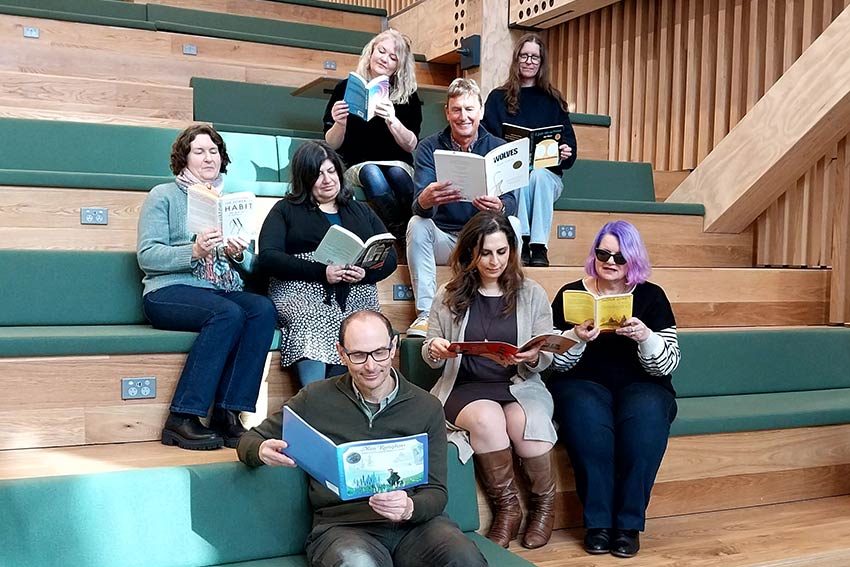
Learn more about our literacy education researchers and the LitPlus community at AUT.
Our publications
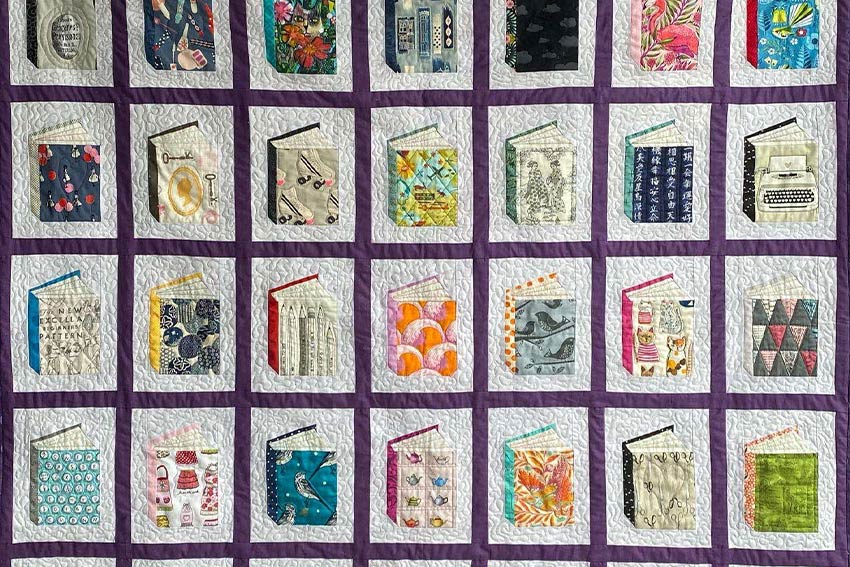 Quilt by LitPlus researcher Jayne Jackson
View the latest publications on literacy education from researchers in the LitPlus community based at AUT.